Spain – A Country of Regional Culinary Traditions
Spanish cuisine is shaped by remarkable regional diversity, from the seafood traditions of the Mediterranean coast to the hearty stews and rustic dishes of the country's interior. Olive oil, garlic, bread, legumes, vegetables and aromatic spices form the foundation of countless traditional recipes. In Castile, where winters can be cold and rural cooking has historically relied on affordable ingredients, warming soups and bread-based dishes have long played an important role in everyday food culture.
Sopa de Ajo – The Traditional Spanish Garlic Soup
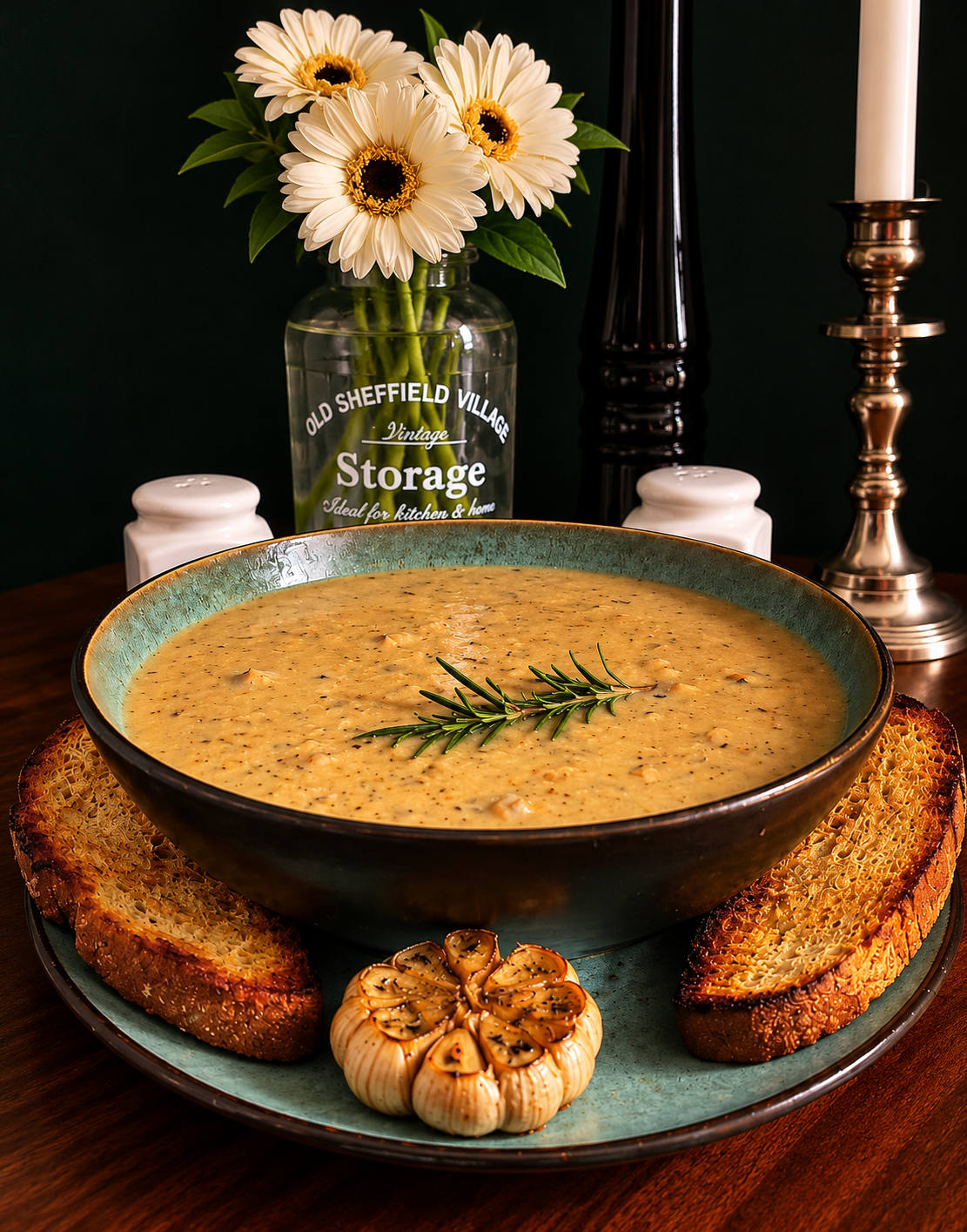
Sopa de Ajo, also known as Sopa Castellana, is a traditional garlic soup particularly associated with Castile. Originally a humble rural dish, it was prepared using stale bread, garlic, olive oil, paprika and water or broth. Many traditional versions include eggs, while others contain ham or other meat products. My Via Veggie Vegan interpretation replaces the meat with vegan bacon and leaves out the eggs. Instead, soy cream, nutritional yeast and a pinch of Kala Namak create a creamy, savory finish with a subtle egg-like note. The result is a warming, aromatic garlic soup that celebrates the comforting character of the Spanish original while being entirely plant-based.
▣ Ingredients (2 servings)
- 10 cloves garlic
- 1 tsp pimentón de la Vera, preferably smoked sweet paprika
- 1 pinch kala namak
- 2 sprigs rosemary, for garnish
- 100 g stale rustic bread or baguette, cut into small cubes
- 100 g vegan bacon cubes
- 1 tbsp nutritional yeast
- 4 tbsp extra virgin olive oil
- 500 ml vegetable broth, preferably homemade
- 100 ml soy creme
- to taste salt & freshly ground black pepper
- 1 whole garlic bulb, for roasting (optional)
♨ Preparation
- Preheat the oven to 200°C conventional heat. Slice approximately 5 mm off the top of the garlic bulb to expose the individual cloves, keeping the bulb intact. Place it in a small ovenproof dish, drizzle with 1 tsp olive oil and season lightly with salt. Cover loosely with aluminum foil and roast for approximately 35–40 minutes until the cloves are completely soft, golden and beautifully caramelized. Remove from the oven and allow to cool slightly before serving alongside the soup. The tender roasted garlic cloves can be squeezed directly out of their skins and spread onto the toasted bread.
- Prepare the Ingredients
Peel and thinly slice the garlic cloves, cut the stale bread into small cubes and chop the fresh parsley. Measure the vegan bacon, olive oil, smoked paprika, vegetable broth, soy cream and nutritional yeast so everything is ready before cooking. - Gently Sauté the Garlic
Heat the olive oil in a saucepan over medium heat. Add the sliced garlic and sauté gently, stirring frequently, until lightly golden and fragrant. Avoid letting the garlic turn dark brown, as it can quickly develop a bitter flavor. - Add the Vegan Bacon and Bread
Add the vegan bacon cubes and fry briefly until lightly browned. Stir in the stale bread cubes and cook for approximately 2–3 minutes, allowing them to absorb some of the aromatic olive oil and develop a lightly toasted surface. - Add the Smoked Paprika
Remove the saucepan briefly from the heat. Sprinkle in the Pimentón de la Vera and stir quickly until the bread and vegan bacon are evenly coated. This prevents the delicate paprika from burning and becoming bitter. - Simmer the Soup
Pour in the warm vegetable broth and stir well. Season lightly with salt and freshly ground black pepper. Cover and simmer gently over low heat for approximately 10 minutes until the bread softens and begins to thicken the broth. - Create the Creamy Vegan Finish
Stir in the soy cream and nutritional yeast. Allow the soup to heat gently for another 2–3 minutes without vigorous boiling. Taste and adjust the seasoning if necessary. Finally, stir in a pinch of Kala Namak just before serving to preserve its distinctive egg-like aroma. - Garnish and Serve
Divide the hot Sopa de Ajo between two soup bowls and garnish generously with freshly chopped parsley. Serve immediately while the soup is warm, creamy and wonderfully aromatic.
Food Story
Team Garlic – And Proud of It!
Some people believe that a little garlic goes a long way. Well, I’m definitely not one of those people! If there’s one team I will proudly support in my kitchen, it’s Team Garlic. And when I discovered that traditional Spanish Sopa de Ajo uses garlic not just as a background flavor but as the actual star of the dish, I knew this recipe had my name written all over it. Ten cloves of garlic for two people? Sounds perfectly reasonable to me! Add smoky paprika, rustic bread and a little vegan bacon, and you’ve already got my full attention.
A Spanish Classic with a Vegan Twist
Traditional Sopa de Ajo often contains eggs and sometimes ham, so naturally I had a few plant-based ideas of my own. Vegan bacon brings a delicious smoky, savory note, while soy cream makes the broth beautifully creamy. Nutritional yeast adds depth, and a little Kala Namak at the very end creates that subtle egg-like flavor without a single egg involved. And the bread? It soaks up all those wonderful garlicky flavors and turns a few simple ingredients into a seriously satisfying bowl of comfort food. Honestly, what’s not to love?
One Important Warning: Kissing May Require Planning!
There is, however, one tiny thing you should know before making this soup: after eating ten cloves of garlic, spontaneous romantic encounters might require a little advance planning. Let’s just say that kissing someone immediately afterwards may not be your greatest idea! But luckily, I have a very simple solution. If there’s someone you’d like to kiss, invite them over and serve them a bowl of Sopa de Ajo too. Problem solved! Two garlic lovers, two steaming bowls of soup and absolutely no reason to complain about anyone’s breath. Romance, Via Veggie Vegan style!
♨ Nutrition per serving
Nutritional values are approximate and may vary depending on the ingredients and products used.
Good to Know
What Is Sopa de Ajo?
Sopa de Ajo literally translates as garlic soup and is one of the classic dishes of traditional Spanish home cooking.
It is particularly associated with Castile, where it is also known as Sopa Castellana.
The soup developed from inexpensive, widely available ingredients such as stale bread, garlic, olive oil, paprika and water or broth.
Its origins are closely connected with rural cooking, where making good use of leftover bread was both practical and economical.
Despite its humble ingredients, Sopa de Ajo can be remarkably rich and satisfying.
Traditional recipes vary between regions and households. Some contain eggs, ham or additional seasonings, while simpler versions rely almost entirely on garlic, bread and paprika.
Sopa de Ajo vs. Sopa Castellana – Is There a Difference?
The names Sopa de Ajo and Sopa Castellana are frequently used interchangeably.
Both refer to garlic-based bread soups traditionally associated with central Spain.
Some cooks distinguish Sopa Castellana as a richer version containing ham or eggs, while Sopa de Ajo may refer to a simpler preparation.
However, these distinctions are not universally consistent, and recipes differ considerably between families and regions.
Rather than representing two completely separate dishes, the names describe closely related traditions.
Why Is Stale Bread Essential?
Bread is much more than a side ingredient in traditional Sopa de Ajo.
As it simmers in the broth, it absorbs liquid and gradually releases starch, helping create a thicker, more substantial soup.
Slightly stale bread is particularly suitable because its drier structure allows it to absorb the aromatic broth.
Using leftover bread also reflects the resourceful nature of traditional rural cooking.
For this recipe, rustic country bread or a firm baguette works particularly well.
Bread that is extremely moldy or spoiled must never be used, even if only a small area appears affected.
Garlic – The Star of the Soup
Garlic belongs to the Allium family, alongside onions, leeks and shallots.
Its distinctive aroma develops when garlic cloves are cut, crushed or sliced, allowing enzymes to interact with naturally occurring sulfur-containing compounds.
One of the resulting compounds is allicin, which contributes to garlic's characteristic pungency.
Heating changes these compounds and produces a softer, sweeter and more rounded flavor.
This is why gently sautéed garlic tastes considerably different from raw garlic.
Garlic contains small amounts of vitamins, minerals and various plant compounds, although the quantities consumed in ordinary recipes do not make it a major source of most nutrients.
Research has investigated garlic's potential effects on cardiovascular health, but garlic should not be considered a replacement for medical treatment.
Why Does Garlic Affect Your Breath?
Garlic contains sulfur-containing compounds responsible for its powerful aroma.
During digestion and metabolism, some of these compounds are transformed into volatile substances that can be released through the breath.
One particularly persistent compound is allyl methyl sulfide, which can circulate in the bloodstream and reach the lungs.
This explains why brushing your teeth does not always completely eliminate garlic breath.
The intensity and duration vary between individuals and depend partly on the amount of garlic consumed.
Sharing the same garlicky meal won't chemically eliminate the aroma, but it may make the situation a little more socially acceptable!
What Is Pimentón de la Vera?
Pimentón de la Vera is a traditional Spanish paprika associated with the La Vera region of Extremadura.
It is produced from peppers that are traditionally dried using oakwood smoke before being ground into a fine powder.
This process gives the spice its characteristic smoky aroma.
Different varieties are available, including sweet, bittersweet and hot versions.
For this recipe, smoked sweet paprika provides the classic flavor without making the soup particularly spicy.
Because paprika contains delicate aromatic compounds, it should not be fried for too long in very hot oil.
Why Does Paprika Burn So Easily?
Ground paprika contains natural sugars, pigments and aromatic compounds that can deteriorate when exposed to excessive heat.
When paprika is added directly to very hot oil, it may darken rapidly and develop a harsh, bitter flavor.
Removing the saucepan briefly from the heat allows the paprika to release its aroma without burning.
Adding the broth shortly afterwards reduces the temperature and stops the frying process.
This small cooking technique makes a noticeable difference to the finished soup.
Traditional Eggs and Vegan Alternatives
Many traditional versions of Sopa de Ajo contain eggs.
Some recipes poach whole eggs directly in the hot broth, while others stir beaten eggs into the soup to create delicate strands.
Eggs contribute protein, richness and a distinctive texture.
My Via Veggie Vegan version takes a different approach.
Instead of trying to reproduce the exact appearance of poached eggs, I use soy cream, nutritional yeast and Kala Namak to create a creamy, savory soup with a subtle egg-inspired flavor.
This is a culinary interpretation rather than an exact nutritional replacement for eggs.
What Makes Kala Namak Special?
Kala Namak, often called Indian black salt, is a mineral salt known for its distinctive sulphurous aroma.
Despite its name, finely ground Kala Namak frequently appears pinkish-grey rather than black.
Its characteristic flavor resembles cooked eggs, making it particularly useful in vegan cooking.
It is commonly added to tofu scrambles, vegan omelettes, plant-based egg salads and other egg-inspired dishes.
In Sopa de Ajo, just a small pinch provides a subtle egg-like note without overpowering the garlic and smoked paprika.
Because prolonged heating can reduce the intensity of its aroma, Kala Namak is best added shortly before serving.
Kala Namak still contains sodium and should be used in moderation, just like other culinary salts.
Nutritional Yeast – More Than Just a Seasoning
Nutritional yeast is a deactivated form of yeast, usually Saccharomyces cerevisiae.
It is valued in plant-based cooking for its savory, nutty and slightly cheese-like flavor.
It contains protein and naturally occurring B vitamins, although the precise nutritional profile varies between products.
Some nutritional yeast products are fortified with additional vitamins, including vitamin B12, while others are not.
Therefore, nutritional yeast should not automatically be considered a reliable source of vitamin B12 unless the product label confirms adequate fortification.
In this soup, nutritional yeast adds savory depth and helps round out the creamy plant-based finish.
Soy Cream – A Plant-Based Alternative to Dairy Cream
Soy cream is commonly made from soybeans or soy protein combined with water, vegetable oil and other ingredients.
It provides a creamy texture without using dairy products.
Depending on the formulation, soy cream may contain less saturated fat than conventional dairy cream.
However, nutritional values vary considerably between brands.
In Sopa de Ajo, soy cream softens the intensity of the garlic and creates a smoother, richer broth.
It is an addition to this vegan interpretation rather than a standard ingredient in traditional Castilian garlic soup.
Vegan Bacon – Smoky Flavor Without Meat
Traditional versions of Sopa Castellana sometimes contain cured ham.
Vegan bacon alternatives can provide a similar savory or smoky contribution without animal-derived ingredients.
They may be made from soy, wheat protein, pea protein or other plant-based ingredients.
Their protein, fat and sodium content varies considerably between products.
Some vegan bacon alternatives are highly seasoned and contain substantial amounts of salt.
For this reason, it is best to taste the soup before adding extra salt, particularly when using a salted vegetable broth.
Olive Oil and Heart Health
Olive oil is an important ingredient in Spanish cuisine and provides much of the aromatic foundation for Sopa de Ajo.
It is rich in monounsaturated fatty acids, particularly oleic acid.
Replacing saturated fats with unsaturated fats can help lower LDL cholesterol levels when incorporated into an overall balanced diet.
LDL carries cholesterol to tissues throughout the body, while HDL participates in transporting excess cholesterol back toward the liver.
Both perform important physiological functions, but elevated LDL cholesterol is a well-established cardiovascular risk factor.
Olive oil also contains various minor plant compounds, particularly in extra virgin varieties.
Its flavor complements garlic and smoked paprika beautifully.
Why Is Sopa de Ajo Such a Good Zero-Waste Recipe?
Traditional Sopa de Ajo demonstrates how leftover ingredients can be transformed into a satisfying meal.
Stale bread, which might otherwise be discarded, becomes one of the soup's essential components.
Garlic skins and clean parsley stems can also be collected for homemade vegetable stock, although their contribution should be balanced with other vegetables.
Garlic skins should be clean and free from mold or spoilage.
If preparing dried vegetable seasoning, use thoroughly cleaned ingredients and dry them completely before storing them in an airtight container.
Any remaining moisture can encourage spoilage, so homemade dried seasonings require careful handling and storage.
How Should Leftover Sopa de Ajo Be Stored?
Allow leftover soup to cool promptly and transfer it to a clean, airtight container.
Refrigerate within two hours of cooking and consume within approximately 3–4 days.
The bread will continue absorbing liquid during storage, so the soup may become considerably thicker.
When reheating, add a little vegetable broth or water to restore the desired consistency.
Heat thoroughly before serving.
For the best texture and flavor, Sopa de Ajo is particularly enjoyable when freshly prepared.