
Maldives – Island Cuisine Shaped by the Indian Ocean
The Maldives is a tropical island nation in the Indian Ocean, southwest of India and Sri Lanka. Its culinary traditions are closely connected to the sea, with tuna, coconut, chili and aromatic ingredients playing central roles in everyday cooking. Indian and Sri Lankan influences have also shaped Maldivian food culture over generations. Simple, fresh ingredients and the combination of savory, spicy and citrus flavors are characteristic of many traditional dishes.
Mas Huni & Roshi – The Classic Maldivian Breakfast
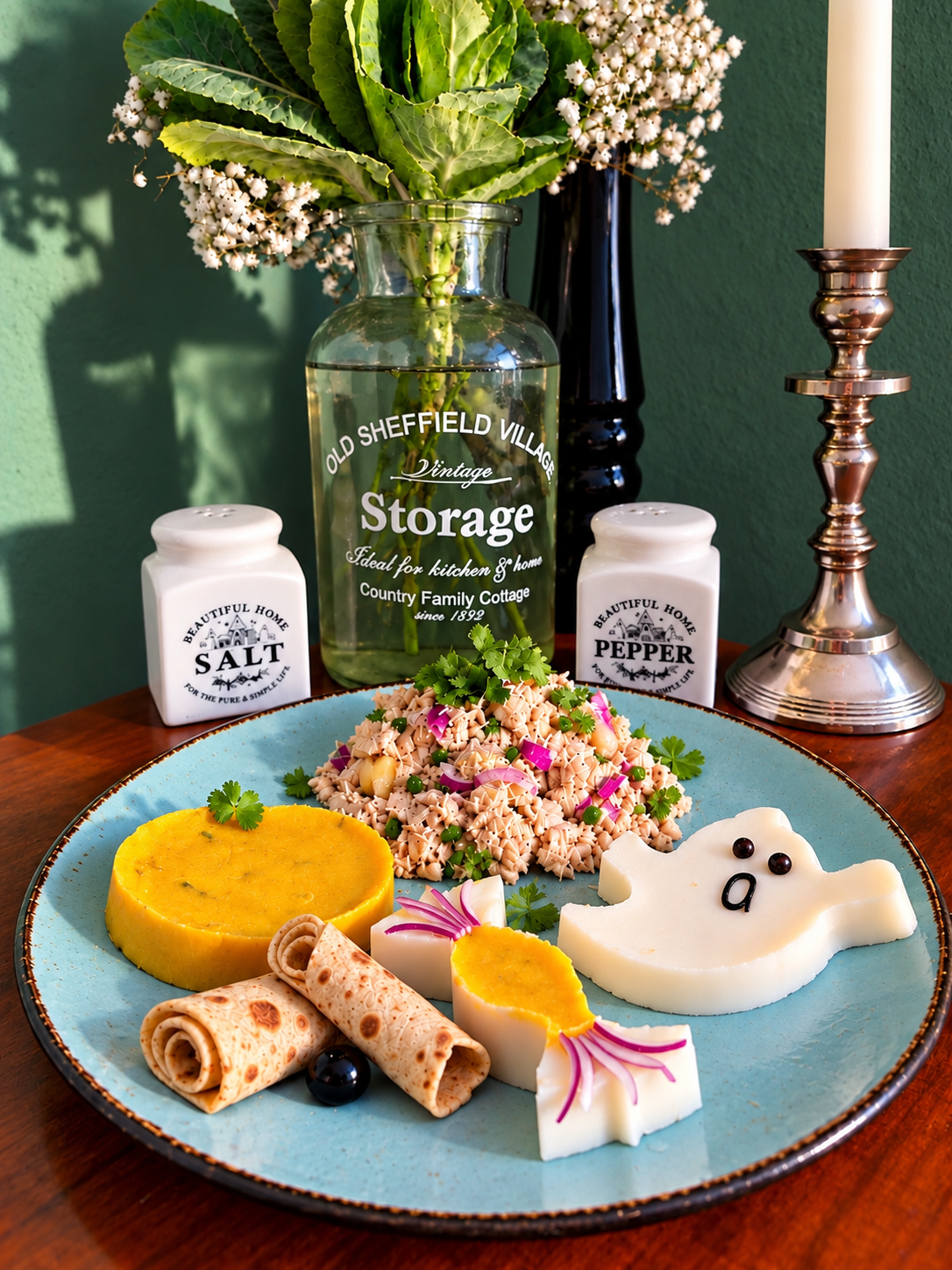
Mas Huni is one of the Maldives' most beloved breakfast dishes. Traditionally prepared with finely shredded tuna, freshly grated coconut, red onion, green chili and lime juice, this refreshing salad is commonly served with Roshi, a thin, unleavened flatbread cooked in a hot pan. My Via Veggie Vegan interpretation replaces tuna with a plant-based alternative and adds three playful Halloween decorations made from silken tofu. The result combines the familiar flavors of a Maldivian breakfast with a little seasonal kitchen magic.
▣ Ingredients (2 servings)
- 1 red onion
- 1-2 green chilis
- 1 lime
- 1/2 tsp salt, for the Mas Huni
- 1/2 tsp salt, for the Roshi
- 1 tsp ground turmeric
- 1 tsp Kala Namak, divided
- 2 black peppercorns, for the ghost's eyes
- 4 sprigs fresh coriander
- 100 g plant-based tuna alternative
- 100 g silken tofu
- 50 g freshly grated coconut
- 100 g wheat flour, type 405 or 550
- 1 g pure agar-agar powder, approximately, depending on the manufacturer's instructions
- 1 pinch vegan black food coloring
- 50-60 ml lukewarm water
- 1 tsp vegetable oil
- to taste salt & freshly ground black pepper
♨ Preparation
- Prepare the Halloween Tofu Mixture
Whisk the silken tofu until completely smooth, then transfer it to a small saucepan. Stir in the agar-agar powder and bring the mixture to a gentle boil, stirring continuously. Simmer according to the manufacturer's instructions, usually for approximately 2 minutes. Divide the hot mixture into two portions. Mix the turmeric and half of the Kala Namak into one portion, leaving it yellow. Season the remaining white portion with the rest of the Kala Namak. - Shape the Halloween Decorations
Place three Halloween cookie cutters – a ghost, pumpkin and wrapped candy – on a flat board lined with baking parchment. Fill the ghost with the white tofu mixture and the pumpkin with the yellow mixture. For the candy, use white tofu for the two outer sections and yellow tofu for the center. Work quickly before the agar-agar begins to set. Refrigerate for approximately 1–2 hours until firm enough to remove from the cutters. - Add the Halloween Details
Carefully remove the cookie cutters. Decorate the ghost with two black peppercorn eyes and a small mouth made from vegan black food coloring. Add a tiny coriander leaf to the pumpkin as its stem. Finish the candy with thin strips of red onion. Keep the decorations refrigerated until serving. - Prepare the Roshi Dough
Combine the wheat flour and salt in a bowl. Add the vegetable oil and gradually incorporate the lukewarm water, kneading until a smooth, soft dough forms. Cover and allow to rest for 10–15 minutes. Divide into four equal portions and roll each into a very thin, round flatbread on a lightly floured surface.
Step 5 – Cook the Homemade Roshi
Heat a non-stick or cast-iron frying pan over medium-high heat. Cook the flatbreads one at a time in the dry pan for approximately 1–2 minutes on each side until lightly golden spots appear. Stack the cooked Roshi under a clean kitchen towel to keep them warm and soft. - Prepare the Vegan Mas Huni
Finely dice the red onion and green chilies, reserving a few onion strips for the Halloween candy. Place the remaining onion and chili in a bowl with the lime juice and salt. Gently massage or mix to release their flavors. Add the drained plant-based tuna, freshly grated coconut and finely chopped coriander. Fold everything together until the mixture is light, moist and evenly combined. Adjust the seasoning to taste. - Assemble the Halloween Breakfast
Divide the Vegan Mas Huni between two plates and arrange the warm Roshi alongside it. Carefully add the Halloween tofu decorations, keeping their shapes intact. Finish with any remaining coriander and serve immediately, ideally with a cup of hot black tea. Remove the decorative peppercorns before eating.
Food Story
From Tropical Paradise to Spooky Season
When you think of breakfast in the Maldives, you probably imagine sunshine, turquoise water, palm trees and the gentle sound of the Indian Ocean. Ghosts, pumpkins and Halloween candy? Probably not! But my culinary journey around the world happened to arrive in the Maldives right in the middle of Spooky Season. And since I was already turning the traditional tuna salad into a vegan creation, I thought: why not give this beautiful island breakfast a little Halloween makeover?
Three Little Halloween Guests Made from Tofu
The Mas Huni itself was wonderfully simple: plant-based tuna, fresh coconut, red onion, chili, lime and coriander, accompanied by homemade Roshi. But the real fun started with the decorations. I transformed silken tofu into three little Halloween characters using agar-agar, turmeric and Kala Namak. A friendly white ghost received peppercorn eyes and a tiny black mouth, a bright yellow pumpkin got a coriander stem, and a wrapped candy was decorated with delicate red onion strips. Thanks to the Kala Namak, my spooky little creations even had a subtle egg-like flavor!
Even Ghosts Deserve a Good Breakfast!
What I particularly loved about this dish was the contrast between the refreshing, slightly spicy coconut salad, the warm homemade flatbread and the soft, savory tofu decorations. Everything worked beautifully together, and the colorful little Halloween guests made me smile before I even took my first bite. That’s the magic of Via Veggie Vegan: discovering authentic food traditions, respecting their origins and occasionally adding a playful personal twist. After all, who says a ghost can’t enjoy breakfast in paradise?
♨ Nutrition per serving
Nutritional values are approximate and may vary depending on the ingredients and products used.
Good to Know
Mas Huni – A Traditional Maldivian Breakfast
Mas Huni is one of the best-known everyday breakfast dishes in the Maldives. The traditional preparation combines finely shredded tuna with grated coconut, onion, chili and lime juice. These ingredients are mixed together to create a refreshing, savory salad with a slightly spicy character.
The dish is typically served with Roshi, a thin, unleavened flatbread. Small pieces of Roshi are torn off and used to scoop up the Mas Huni, making the bread an essential part of the traditional eating experience.
Although tuna is central to the original recipe, replacing it with a plant-based alternative allows the characteristic combination of coconut, onion, chili and lime to remain recognizable.
What Is Roshi?
Roshi is a traditional Maldivian flatbread made from a simple dough of flour, water, salt and sometimes oil. It is rolled thinly and cooked in a hot pan rather than baked in an oven.
Its texture is soft and flexible when freshly prepared, making it ideal for picking up salads and savory accompaniments.
Roshi shares similarities with other South Asian flatbreads, reflecting the historical culinary connections between the Maldives, India and Sri Lanka.
Why Is Coconut So Important in Maldivian Cuisine?
Coconut palms are closely associated with island life in the Maldives. Coconut is used in numerous traditional preparations, including salads, curries, sweets and beverages.
Freshly grated coconut contributes a delicate sweetness, pleasant texture and natural richness to Mas Huni.
Coconut contains dietary fiber and fat, including a relatively high proportion of saturated fatty acids. While coconut can be part of a balanced diet, it is worth remembering that regularly replacing saturated fats with unsaturated fats can help maintain healthier LDL cholesterol levels.
For Mas Huni, fresh coconut is particularly valuable because it contributes both moisture and the characteristic texture of the dish.
Vegan Tuna – A Plant-Based Alternative to Fish
Traditional Mas Huni is prepared with tuna, one of the most important fish in Maldivian food culture.
Plant-based tuna alternatives aim to reproduce the flaky texture and savory flavor of fish using ingredients such as soy protein, pea protein, wheat protein or other plant-based components.
The nutritional composition varies significantly between products. Some are rich in protein, while others contain more starch, oil or added flavorings.
Unlike conventional tuna, plant-based alternatives do not naturally provide the same amounts of marine omega-3 fatty acids EPA and DHA unless specifically fortified. Algae-derived omega-3 products can provide these fatty acids in a vegan diet.
For this recipe, choose a plant-based tuna alternative with a flaky texture and a relatively mild flavor so the coconut, lime and chili remain prominent.
What Exactly Is Agar-Agar?
Agar-agar is a plant-based gelling ingredient extracted from certain species of red algae.
It is widely used in Asian cooking and is a popular vegan alternative to animal-derived gelatin.
Unlike gelatin, agar-agar generally requires sufficient heating to dissolve properly. Many powdered products need to be brought to a boil and simmered briefly, although exact temperatures, quantities and heating times depend on the manufacturer.
Once dissolved, agar-agar begins to form a gel as the mixture cools. Refrigeration helps chill the finished decorations, but agar-based gels can often set even at room temperature.
Agar-agar creates a firmer, more brittle texture than gelatin, which makes it particularly useful for shaped decorations.
For this recipe, the correct dosage is especially important because a small amount of silken tofu must hold its shape inside Halloween cookie cutters.
What Makes Kala Namak Taste Like Eggs?
Kala Namak, commonly known as Indian black salt, is a mineral salt traditionally used in South Asian cooking.
Its distinctive sulfurous aroma comes from sulfur-containing compounds that produce a smell reminiscent of cooked eggs.
Despite its name, finely ground Kala Namak often appears pinkish-grey rather than black.
It has become particularly popular in vegan cooking because it adds an egg-like flavor to tofu scrambles, vegan omelettes and other plant-based egg alternatives.
In these Halloween decorations, Kala Namak transforms neutral silken tofu into a savory, subtly egg-flavored accompaniment.
For the strongest egg-like aroma, Kala Namak can also be added after heating. In this recipe, it is mixed into the warm tofu mixture before setting.
Silken Tofu – A Versatile Vegan Egg Alternative
Silken tofu is made from coagulated soy milk and has a particularly soft, smooth consistency.
Unlike firm tofu, it contains a high proportion of water and can easily be blended into creamy mixtures.
It is widely used in vegan desserts, sauces, puddings, quiches and egg-inspired dishes.
Silken tofu provides plant-based protein and is naturally free from cholesterol. Its exact protein and mineral content varies depending on the manufacturer and the coagulants used.
Combined with Kala Namak, turmeric and agar-agar, it becomes a versatile base for shaped, savory breakfast decorations.
Turmeric provides the yellow color, Kala Namak contributes the egg-like aroma and agar-agar helps the mixture hold its shape.
Turmeric – Natural Color with a Long Culinary History
Turmeric is a spice made from the rhizome of Curcuma longa, a plant belonging to the ginger family.
Its characteristic golden-yellow color comes primarily from curcuminoid pigments, including curcumin.
Turmeric has a long history in South Asian cooking and is frequently used in curries, rice dishes and spice mixtures.
In this recipe, its main purpose is culinary rather than medicinal: it gives the pumpkin and candy decorations their cheerful yellow appearance.
Only a small amount is needed for color. Larger quantities can produce a noticeably earthy and slightly bitter flavor.
Halloween Decorations – Completely Plant-Based
Traditional decorative breakfast creations sometimes use boiled eggs, egg whites or egg-based mixtures.
These Halloween figures demonstrate how silken tofu can be used to create a playful plant-based alternative.
The white ghost, yellow pumpkin and two-colored candy are made from the same basic tofu mixture, divided and colored before setting.
Black peppercorns, coriander leaves, red onion and vegan food coloring provide the finishing details.
Whole peppercorns are decorative only and should be removed before eating, particularly when serving children.
Black Tea – The Classic Maldivian Breakfast Companion
Black tea is a familiar part of everyday life in the Maldives and is commonly served with breakfast.
Tea is often referred to locally as sai and may be enjoyed with sugar or milk, depending on preference.
A hot cup of black tea pairs particularly well with the fresh coconut, lime and chili flavors of Mas Huni.
For a completely vegan breakfast, enjoy it plain or with your favorite plant-based milk alternative.
You may also like
♡
You may also like
Vegan Chipsi Mayai with Tomato & Avocado Salad
You may also like