Halloween – A Celebration of Pumpkins and Creativity
Halloween is celebrated on October 31 and has roots in traditions associated with the Celtic festival of Samhain, later influenced by Christian observances and regional customs. Today, pumpkins are among its most recognizable symbols, particularly in the form of carved jack-o'-lanterns. Pumpkin-shaped foods have also become a popular way to bring a playful seasonal touch to the table. This homemade cashew cheese takes inspiration from that tradition, transforming a savory plant-based spread into an edible Halloween decoration.
Homemade Cashew Cream Cheese – A Plant-Based Alternative
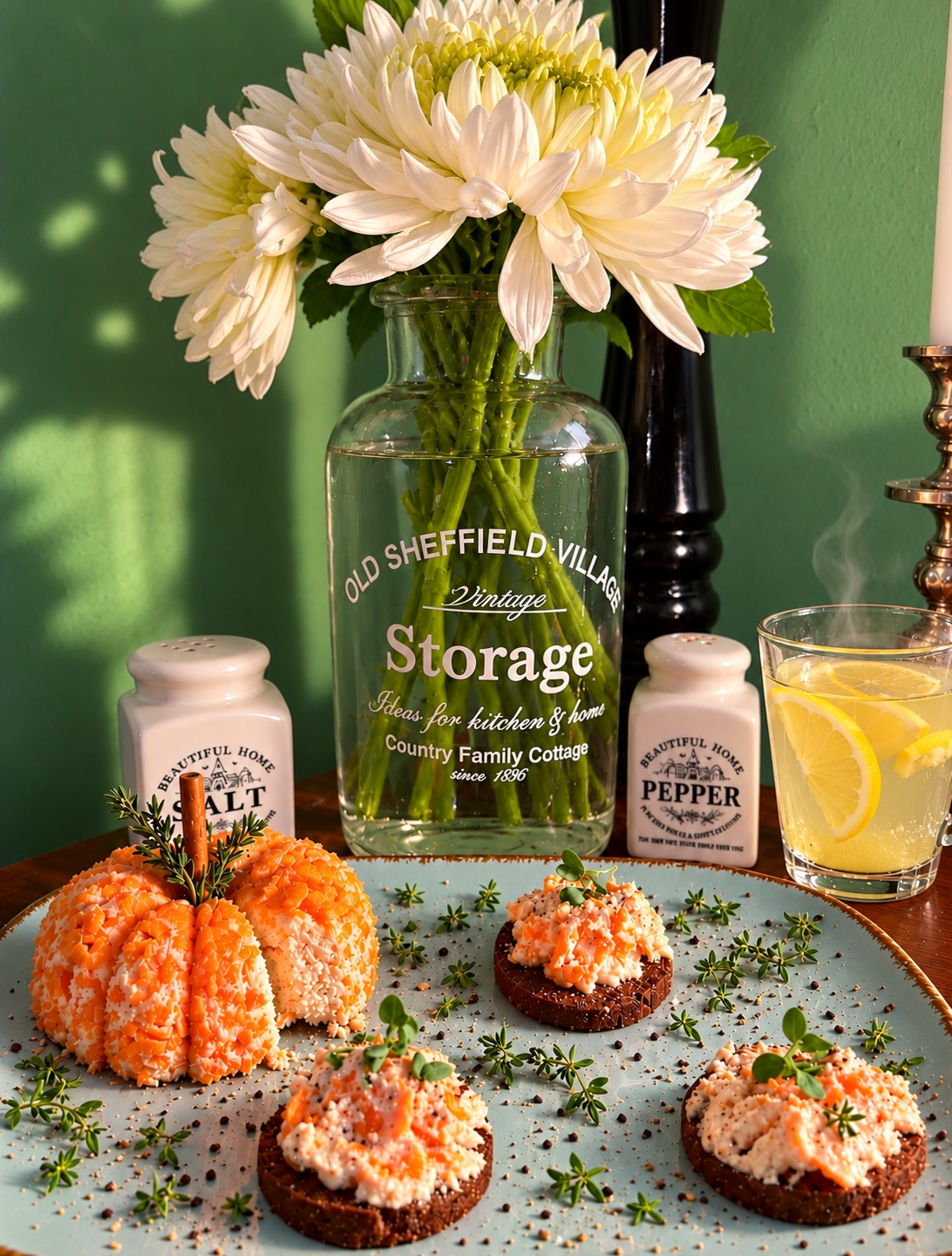
Cashew-based cheese is a modern plant-based alternative to dairy cheese rather than a traditional regional dish. Soaked cashews create a creamy base, while nutritional yeast, lemon juice, garlic and thyme provide a savory, slightly tangy flavor. Agar-agar helps the mixture hold its shape once chilled. For this Halloween version, the cashew cheese is divided into two portions, coated with grated carrots and shaped using kitchen string. A pretzel stick becomes the pumpkin stem, and fresh thyme completes the decoration. The result is a creamy, spreadable vegan cheese with a wonderfully festive appearance.
▣ Ingredients (2 servings)
- 1 carrot
- 125 g natural cashews, raw, unsalted and unroasted
- 2 tbsp nutritional yeast
- 1/2 tsp garlic powder
- 1 pinch turmeric
- 1/2 tsp dried thyme
- 1 tsp agar-agar powder, approximately 2 g
- 4 sprigs fresh thyme
- 100 ml water
- 1 tbsp fresh lemon juice
- to taste fresh lemon zest
- 2 sticks pretzel sticks
- Additional boiling water, for soaking the cashews
- to taste salt & freshly ground black pepper
♨ Preparation
- 1. Prepare the Cashews
Place the raw, unsalted and unroasted cashews in a heatproof bowl.
Cover them completely with boiling water.
Allow the cashews to soak for approximately 30–60 minutes until softened.
For the creamiest possible result, soak the cashews overnight in cold water in the refrigerator instead.
Drain the soaked cashews thoroughly.
Discard the soaking water. - 2. Prepare the Pumpkin Moulds
Cut two large pieces of food-safe cling film and spread them out on a clean work surface.
Prepare eight pieces of sturdy kitchen string.
Arrange four pieces of string in a star-shaped pattern beneath each sheet of cling film, crossing them at the center.
The strings should extend far enough beyond the cling film to be tied together later.
Keep both prepared moulds within easy reach. - 3. Prepare the Carrot Coating
Wash and peel the carrot.
Finely grate it using a kitchen grater.
Distribute the grated carrot evenly over the central area of both pieces of cling film.
Leave enough uncovered film around the edges to gather and close the packages later.
The carrot will form the orange outer coating of the finished cheese pumpkins. - 4. Prepare the Cashew Cheese Base
Transfer the drained cashews to a high-speed blender.
Add the nutritional yeast, lemon juice, lemon zest, garlic powder, turmeric, dried thyme and salt.
Blend until the ingredients are thoroughly combined.
Scrape down the sides of the blender if necessary.
Do not add the 100 ml water or agar-agar at this stage.
Both ingredients must be heated separately to activate the agar-agar properly. - 5. Activate the Agar-Agar
Pour 100 ml water into a small saucepan.
Add the agar-agar powder.
Whisk thoroughly until the powder is evenly dispersed.
Bring the mixture to a full, bubbling boil while stirring continuously.
Allow it to boil vigorously for approximately 1–2 minutes, following the instructions on the agar-agar packaging.
Continue whisking to prevent lumps from forming or the mixture sticking to the saucepan.
The agar-agar must be properly heated to develop its setting properties. - 6. Combine the Cashew Mixture and Agar-Agar
Immediately pour the boiling-hot agar-agar mixture into the blender containing the prepared cashew cheese base.
Blend straight away until the mixture becomes completely smooth, creamy and evenly combined.
Work quickly.
Agar-agar begins to set as it cools, so the finished mixture must be transferred to the prepared moulds without delay. - 7. Fill the Pumpkin Moulds
Divide the warm cashew cheese mixture into two equal portions.
Place one portion in the center of each prepared sheet of cling film, directly on top of the grated carrot.
Use a spoon or spatula to form two compact mounds.
Make sure the grated carrot remains distributed around the outside of the cheese mixture. - 8. Shape the Cheese Pumpkins
Carefully gather the edges of the first sheet of cling film around the cashew cheese.
Bring the film together above the mixture and twist gently to close the package.
Shape the cheese into a rounded pumpkin-like form.
Repeat with the second portion.
Do not squeeze the packages too tightly.
The aim is to create a rounded shape without forcing the soft mixture out of the cling film. - 9. Tie the Pumpkin Segments
Take the four prepared kitchen strings positioned beneath the first wrapped cheese pumpkin.
Bring the ends of each string up around the package.
Tie the strings carefully at the top.
The crossing strings create the characteristic grooves and segments of a pumpkin.
Tighten them only enough to define the pumpkin shape.
Avoid pulling too firmly, as this could deform the soft cheese or tear the cling film.
Repeat with the second cheese pumpkin. - 10. Chill the Cashew Cheese Pumpkins
Place both wrapped and tied cheese pumpkins carefully on a plate or in a shallow container.
Transfer them to the refrigerator.
Allow them to chill until completely firm.
For the best shape and texture, refrigerate overnight.
Avoid handling the pumpkins unnecessarily while they are setting. - 11. Remove the Wrapping
Once the cashew cheese pumpkins are completely chilled and firm, remove them from the refrigerator.
Carefully cut and remove the kitchen strings.
Gently unwrap the cling film.
Take your time to preserve the pumpkin segments and carrot coating.
Transfer both cheese pumpkins to a serving plate. - 12. Decorate the Pumpkins
Insert one pretzel stick into the center of each cheese pumpkin to create the stem.
Depending on the size of the pumpkin, shorten the pretzel stick if necessary.
Decorate each pumpkin with two sprigs of fresh thyme.
Arrange the thyme around the stem to resemble pumpkin leaves and tendrils. - 13. Serve the Pumpkin-Shaped Cashew Cheese
Serve the finished cashew cheese pumpkins chilled.
They are delicious with pumpernickel, freshly toasted bread, crackers or a savory Halloween breakfast platter.
Keep refrigerated until ready to serve.
Food Story
Is It a Pumpkin? Is It a Tangerine?
Nope! It’s homemade cashew cream cheese. And yes, I know exactly what you’re thinking. Why would anyone go to all this trouble to make cheese look like a pumpkin? Well, because it’s Halloween. And because apparently, simply spreading vegan cream cheese on bread isn’t quite exciting enough for me anymore.
My Little Halloween Cheese Experiment
It all started with cashews, nutritional yeast, lemon and a little thyme. Nothing particularly spooky about that. But then came the grated carrots, the cling film and the kitchen string. Suddenly, my kitchen looked less like a place where someone was preparing breakfast and more like a very small pumpkin workshop. Eight pieces of string, two carefully wrapped bundles and a little patience later, my future cheese pumpkins were ready for the refrigerator.
The Magic Happens Overnight
And then comes the hardest part: waiting. Agar-agar needs time to set, and these little pumpkins are definitely worth leaving alone overnight. The next morning, it’s time for the big reveal. Carefully remove the strings, unwrap the cling film and hope that the pumpkin shape has survived. Add a pretzel-stick stem, a little fresh thyme and suddenly a bowl of cashew cream cheese has turned into a proper Halloween breakfast centerpiece.
Even Witches Catch Colds
For my Halloween breakfast, I served the little cashew pumpkin with pumpernickel and a steaming lemon drink. And there was one rather unwelcome guest at the table: my cold. Achoo! Apparently, even witches aren’t immune to catching a cold during spooky season. But at least breakfast looked cheerful. And when life gives you lemons, you might as well make a hot lemon drink and serve it with a homemade cheese pumpkin.
Spooky on the Outside, Delicious on the Inside
Underneath that bright orange carrot coating is a creamy, savory cashew cheese with garlic, thyme and a gentle hint of lemon. No dairy, no actual pumpkin and absolutely no reason to wait until Halloween to make it again. Although I have to admit, turning cheese into vegetables is becoming a rather entertaining hobby. Welcome to Via Veggie Vegan Vunderland, where even breakfast likes to dress up!
♨ Nutrition per serving
Nutritional values are approximate and may vary depending on the ingredients and products used.
Good to Know
What Is Cashew Cream Cheese?
Cashew cream cheese is a plant-based alternative to traditional dairy cream cheese. Soaked cashews are blended with water and seasonings to create a smooth, creamy consistency. Nutritional yeast, lemon juice and herbs add savory and tangy notes. Depending on the recipe, cashew cheese can be served as a soft spread, fermented for a more complex flavor or thickened with ingredients such as agar-agar to create a firmer shape. This Halloween version transforms the creamy mixture into two decorative little pumpkins.
Why Soak Cashews?
Soaking softens cashews and makes them easier to blend into a smooth mixture. A short soak in hot water is convenient when time is limited, while an overnight soak in the refrigerator allows the nuts to soften gradually. The soaking water should be discarded before blending. Using a high-speed blender helps achieve a particularly fine, creamy texture without noticeable pieces of cashew.
What Is Agar-Agar?
Agar-agar is a plant-based gelling agent obtained from certain types of red algae. It is widely used as an alternative to animal-derived gelatin. Unlike gelatin, agar-agar generally needs to be heated to a full boil to dissolve properly and develop its setting properties. It forms a gel as the mixture cools. The exact setting strength can vary between products, so following the manufacturer's instructions is important.
Why Must Agar-Agar Be Boiled?
Agar-agar does not behave like ordinary starch or gelatin. Its gelling components need sufficient heat to dissolve in the liquid. Bringing the water and agar-agar to a full boil and maintaining it for approximately 1–2 minutes helps ensure proper dissolution, provided this matches the product instructions. If the agar-agar is not heated sufficiently, the finished cheese may fail to hold its pumpkin shape.
Why Is Timing So Important?
Agar-agar starts forming a gel as its temperature falls. Once the hot agar-agar solution is combined with the cooler cashew mixture, thickening can begin relatively quickly. Preparing the carrot coating, cling film and kitchen strings in advance prevents unnecessary delays. Working promptly also helps avoid lumps and makes the cheese easier to divide and shape.
What Does Nutritional Yeast Add?
Nutritional yeast is a deactivated yeast commonly used in plant-based cooking for its savory, slightly nutty and cheese-like flavor. It contains protein and various B vitamins, although the exact nutritional profile depends on the product and whether it has been fortified. Not all nutritional yeast contains vitamin B12, so fortified products should be checked individually. In this recipe, nutritional yeast helps give the cashew cheese its characteristic savory taste.
Why Add Lemon Juice and Zest?
Lemon juice provides acidity that balances the richness of the cashews and gives the cheese a slightly tangy flavor. Lemon zest contains aromatic compounds from the peel, contributing a fresh citrus fragrance without adding as much acidity as the juice. Together, they make the cashew cheese taste brighter and less heavy. Use only the finely grated outer yellow part of the peel to avoid the bitter white pith.
What Makes the Pumpkin Orange?
The orange color comes from finely grated carrots, supported by a small pinch of turmeric in the cheese mixture. Carrots contain beta-carotene, a pigment responsible for their characteristic color. Beta-carotene is also a provitamin A carotenoid, meaning the body can convert some of it into vitamin A as needed. The carrot coating adds a subtle sweetness and a pleasant texture to the savory cashew cheese.
Cashews – More Than Just a Creamy Base
Cashews provide plant-based protein, predominantly unsaturated fatty acids and minerals such as magnesium, copper and zinc. Their naturally mild flavor and relatively soft texture make them particularly suitable for creamy vegan preparations. However, cashews are also energy-dense, so their nutritional contribution should be considered in relation to portion size.
Cashews, Fats and Cholesterol
As plant foods, cashews contain no dietary cholesterol. Their fat content consists predominantly of unsaturated fatty acids, although they also contain some saturated fat. Replacing some saturated fats in the diet with unsaturated fats can help lower LDL cholesterol, an important cardiovascular risk factor. This cashew-based spread offers a dairy-free alternative to conventional cream cheese, although its nutritional composition is different.
LDL and HDL Cholesterol – Understanding the Difference
LDL and HDL are lipoproteins that transport cholesterol through the bloodstream. Elevated LDL cholesterol contributes to the development of atherosclerosis and increases cardiovascular risk. HDL participates in transporting cholesterol back toward the liver, but higher HDL levels alone do not guarantee cardiovascular protection. Overall dietary patterns, physical activity and other individual factors influence cardiovascular health.
Why Use Fresh and Dried Thyme?
Dried thyme contributes a concentrated herbal flavor to the cashew cheese mixture, while fresh thyme adds fragrance and a decorative finishing touch. Thyme contains aromatic compounds, including thymol, that contribute to its characteristic flavor. The fresh sprigs also resemble miniature pumpkin leaves and tendrils, making them particularly suitable for this Halloween presentation.
Why Kitchen String Creates Pumpkin Segments
Real pumpkins often have visible ribs running from their stems toward their bases. By arranging kitchen strings in a star-shaped pattern around the wrapped cashew cheese, gentle pressure creates similar grooves. As the agar-agar mixture firms up in the refrigerator, the cheese retains its segmented shape. The strings should be tightened carefully to avoid damaging the soft mixture or its wrapping.
Why Let the Cheese Set Overnight?
Agar-agar begins to gel as the mixture cools, but refrigeration allows the entire cheese pumpkin to reach a consistent temperature and develop a firmer texture. An overnight rest also makes removing the strings and cling film easier. Although the mixture may become firm sooner, allowing sufficient chilling time helps preserve the delicate pumpkin shape during serving.
Halloween Pumpkins – From Lanterns to Edible Decorations
Pumpkins have become one of the most recognizable symbols of Halloween. The tradition of carving lanterns developed from earlier customs involving carved root vegetables, particularly turnips, before pumpkins became popular in North America. Today, pumpkin shapes appear in decorations, costumes and seasonal food creations. These little cashew cheese pumpkins bring that tradition to the breakfast table without containing any actual pumpkin.
Why Pretzel Sticks Make Perfect Pumpkin Stems
Pretzel sticks are firm enough to stand upright in the chilled cashew cheese and provide a playful edible alternative to decorative stems. Their salty flavor also complements the savory cashew mixture. Insert them shortly before serving, as they gradually absorb moisture and lose their crispness when left in contact with the cheese.
Zero Waste – Use Leftover Carrot and Thyme
Any leftover grated carrot can be added to salads, soups, vegetable patties or sandwich fillings. Tender thyme leaves can be used in dressings and savory dishes, while clean stems can contribute flavor to homemade vegetable stock. Making use of these ingredients helps reduce unnecessary kitchen waste.
How to Store Homemade Cashew Cream Cheese
Store the finished cashew cheese pumpkins in a covered, airtight container in the refrigerator and consume them within approximately 3–4 days if prepared and handled hygienically. Keep them properly chilled and avoid leaving them at room temperature for extended periods. Remove the decorative pretzel sticks before storage, as they soften when exposed to moisture. Discard the cheese if it develops an unusual smell, visible mold or other signs of spoilage.
A Lower-Waste Alternative to Cling Film
Reusable food-safe silicone moulds can provide an alternative to disposable cling film when shaping homemade cashew cheese. Pumpkin-shaped moulds are particularly convenient because they create decorative grooves without requiring kitchen string. However, the finished appearance may differ from the hand-tied version. Choosing reusable equipment where practical can help reduce packaging waste in the kitchen.