France – Alsace and Its Unique Culinary Heritage
Alsace is a beautiful region in northeastern France, bordering Germany and Switzerland. Its cuisine reflects centuries of French and German cultural influences, combining rustic traditions with hearty, comforting flavours. One of the region's most famous specialities is Flammkuchen, known in French as tarte flambée. Traditionally baked in intensely heated wood-fired ovens, this thin, crispy flatbread is a beloved part of Alsatian food culture. Its classic combination of crème fraîche, onions and bacon demonstrates how just a few simple ingredients can create something wonderfully satisfying.
What Is Vegan Halloween Flammkuchen?
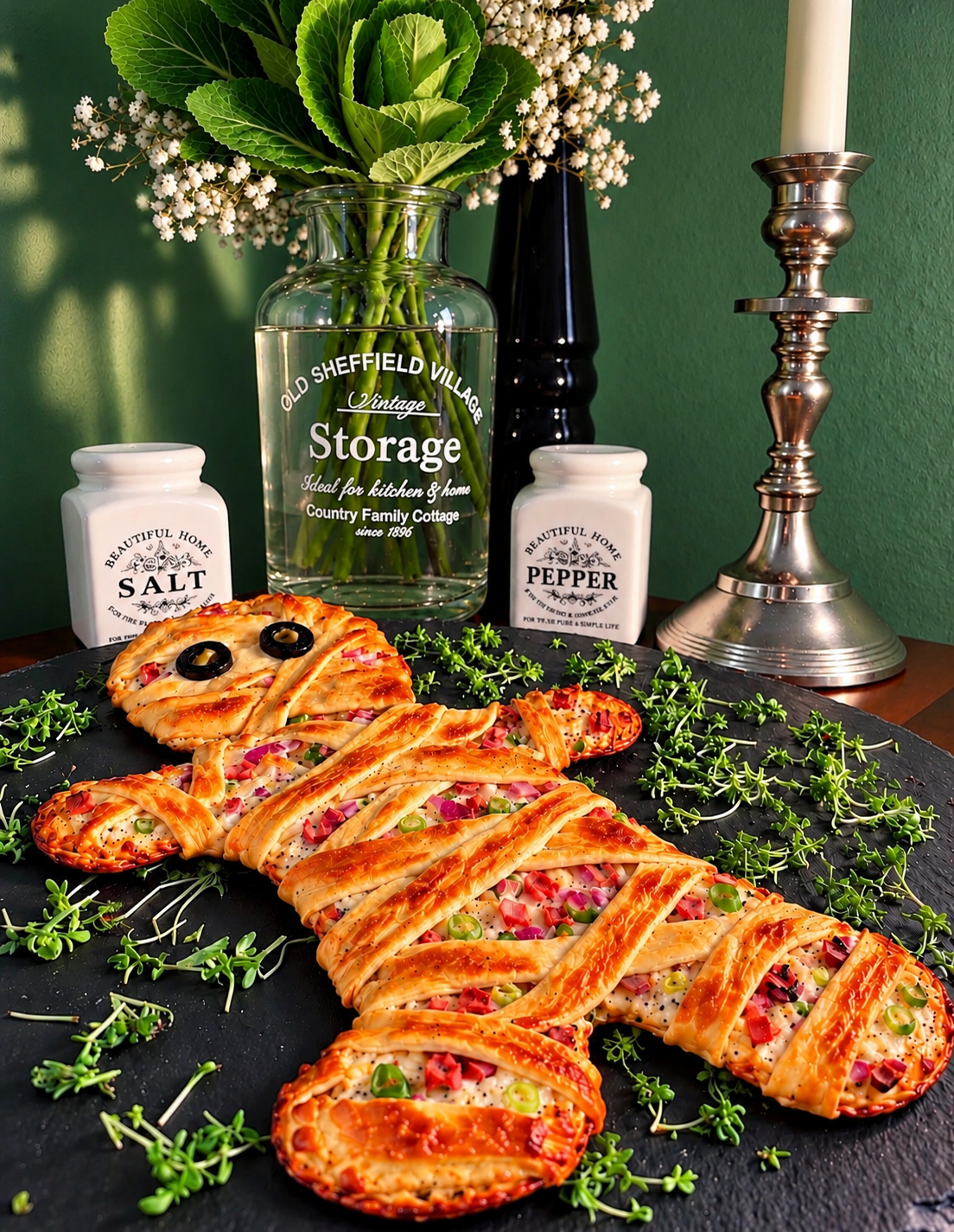
Vegan Halloween Flammkuchen is my playful, plant-based interpretation of the traditional Alsatian tarte flambée. Instead of dairy crème fraîche and bacon, I use a creamy vegan alternative and savoury plant-based bacon cubes, combined with red onions, spring onions, nutritional yeast and freshly grated nutmeg. The homemade yeast-free dough is rolled out thinly and shaped into two adorable Halloween mummies, complete with crispy pastry bandages and spooky olive eyes. This creative Via Veggie Vegan version brings together authentic Alsatian inspiration, delicious vegan ingredients and a generous helping of Halloween imagination – proving that even a French culinary classic can enjoy a wonderfully spooky makeover!
▣ Ingredients (2 servings)
- 150 g wheat flour all-purpose flour
- 100 ml water
- 1 pinch salt
- 4-5 tbsp vegan crème fraîche alternative
- 1 red onion
- 125 g plant-based bacon cubes
- 1 spring Onion
- 1 tsp nutritional yeast
- 1 black olive
- 1 green olive
- to taste salt / freshly ground black pepper
- to taste freshly grated nutmeg
♨ Preparation
- Prepare the Dough
Combine the flour, water and a small pinch of salt in a mixing bowl. Knead until a smooth, pliable dough forms. Cover and leave to rest for approximately 8–10 minutes. - Prepare the Toppings
Peel the red onion and cut it into very thin strips. Wash the spring onion and slice the green part into fine rings. Prepare the plant-based bacon cubes and cut the black and green olives into small slices for the mummy eyes. - Shape the Mummies
Preheat the oven to 200°C (top and bottom heat).
Roll out the dough very thinly on a lightly floured surface, approximately 3 mm thick. Divide and shape the dough into two mummy silhouettes, with a rounded head, body, arms and legs.
Carefully fold the outer cut edges slightly upwards to create a small raised border that will help keep the toppings in place.
Reserve the remaining dough for the mummy bandages. - Add the Creamy Topping
Spread a thin, even layer of vegan crème fraîche alternative over both mummy shapes, keeping the raised edges free.
Using a small shaker or fine sieve, sprinkle the nutritional yeast evenly over the crème fraîche. Season with freshly ground black pepper. - – Add the Vegetables and Bacon
Distribute the spring onion rings, finely sliced red onion and plant-based bacon cubes evenly over both mummies.
Leave enough space around the head area for the olive eyes and the pastry bandages. - Wrap the Mummies
Roll out the reserved dough and cut it into thin strips, approximately 1 cm wide.
Carefully lift one side of a mummy's head and tuck about 0.5 cm of a dough strip underneath. Bring the strip diagonally across the face or body and tuck the opposite end approximately 0.5 cm underneath the other side.
Continue wrapping the mummies with overlapping and crossing strips, leaving small gaps so the delicious filling remains visible.
There is no need to wrap the strips completely around the back. Securing the ends underneath the edges is enough to create the appearance of authentic mummy bandages.
Using the blunt back of a knife, gently press small indentations into the individual strips to give the bandages extra definition and texture.
Position the black and green olive slices as spooky mummy eyes. - – Bake Until Golden
Carefully transfer the two mummies onto a baking tray lined with baking parchment.
Bake in the preheated oven at 200°C for approximately 15–18 minutes, or until the dough is golden brown and crisp.
Keep an eye on the thinner bandage strips towards the end of the baking time to prevent excessive browning. - Add the Finishing Touch
Remove the mummies from the oven and finish with a little freshly grated nutmeg.
Allow them to cool briefly before transferring them to a serving platter. Arrange on a bed of fresh cress or microgreens for an extra spooky Halloween presentation.
Serve warm and enjoy your deliciously creepy Alsatian mummies!
Food Story
From Shepherd’s Pie to Scottish Rumbledethumps
My original plan was to make a classic Shepherd’s Pie. A lovely, comforting British dish with a golden mashed potato topping – exactly the kind of food I adore when the weather gets colder. But then I noticed that so many vegetarian and vegan versions contain mushrooms. And mushrooms? Absolutely not! I refuse to eat them. Why? Because that’s where the Smurfs live, obviously! And I certainly wouldn’t want to make Papa Smurf homeless. So, in the interest of protecting an entire tiny blue community, I went looking for another comforting British classic. That’s when I discovered Scottish Rumbledethumps. First of all, what a wonderfully ridiculous name! Second, potatoes, cabbage and cheese? Now we’re talking. My Halloween dinner plans had officially taken a very Scottish turn.
A Spiderweb Made of Cheese
As soon as I realised that Rumbledethumps is traditionally finished with a generous layer of cheese, my Halloween imagination took over. Why settle for an ordinary golden crust when you can create a spooky spiderweb instead? I layered tender savoy cabbage leaves with creamy mashed potatoes, Brussels sprouts, sautéed onions and garlic, almost like a little Scottish lasagne. Then came the fun part. Armed with two different colours of plant-based cheese slices, a knife and a surprising amount of patience, I started constructing my edible spiderweb. Strip by strip, the pattern slowly appeared across the gratin. Was it a little fiddly? Absolutely. Did I spend more time arranging cheese than any reasonable person probably should? Quite possibly. But that’s Halloween cooking for you. Sometimes the decoration is half the adventure!
A Little Scandinavian Rebellion
Rumbledethumps is often served alongside hearty Scottish meat dishes or sausages. But apparently, staying within one country’s culinary borders was too easy for me. So I decided to pair my Scottish potato gratin with Swedish-style vegan cheese sausages, sliced and pan-fried until beautifully golden. Scotland meets Sweden – and nobody even needed a passport! Of course, one spiderweb wasn’t quite enough. I still had a little leftover pizza dough, and throwing perfectly good food away simply isn’t my style. So I transformed it into a crispy little spider, complete with carefully shaped legs. Perched behind the sausages, my eight-legged guest looked ready to crawl straight into dinner. The result? Creamy potatoes, tender cabbage, golden vegan cheese, crispy sausages and one very mischievous spider. No mushrooms, no homeless Smurfs and absolutely no animal products. Just a wonderfully comforting Scottish classic with a Scandinavian sidekick and a generous helping of Halloween madness. Welcome to my Via Veggie Vegan kitchen!
♨ Nutrition per serving
Nutritional values are approximate and may vary depending on the ingredients and products used.
Good to Know
A French Classic from Alsace
Flammkuchen, also known as tarte flambée in French, is a traditional speciality from Alsace, a region in northeastern France with strong French and German culinary influences. Its German name literally translates to "flame cake", referring to its origins in wood-fired ovens. Historically, thin pieces of dough were baked in the intense heat of these ovens, creating the characteristic crispy texture that makes Flammkuchen so distinctive.
Traditionally Thin and Crispy
Unlike traditional Italian pizza, Flammkuchen is usually prepared with a very thin, yeast-free dough. The classic Alsatian topping consists of crème fraîche, thinly sliced onions and bacon. Its appeal lies in the contrast between the delicate, crispy base and the creamy, savoury topping. Rolling the dough thinly and spreading the crème fraîche sparingly are essential for achieving this characteristic texture.
How to Make Traditional Flammkuchen Vegan
The classic Alsatian recipe contains dairy crème fraîche and bacon, but both can be replaced with plant-based alternatives. Vegan crème fraîche provides the creamy base, while plant-based bacon cubes contribute a smoky, savoury flavour. Nutritional yeast adds additional umami, and freshly grated nutmeg complements the onions and creamy topping. The traditional flour-and-water dough is already naturally vegan when prepared without animal-derived ingredients.
Halloween Meets Alsatian Tradition
The mummy shape is a playful Via Veggie Vegan Halloween interpretation rather than a traditional Alsatian presentation. By cutting the dough into thin strips and arranging them like bandages across the filled pastry, a familiar regional speciality becomes a spooky centrepiece. Black and green olive slices create the mummy eyes, while the visible filling gives each little creature its own personality.
Why Add Freshly Grated Nutmeg After Baking?
Nutmeg contains aromatic compounds that contribute warm, slightly sweet and spicy notes. Some of these aromas can diminish during prolonged exposure to heat. Adding a small amount of freshly grated nutmeg immediately after baking helps preserve its fragrance and gives the creamy Flammkuchen topping an elegant finishing touch. A little goes a long way, as nutmeg has a naturally intense flavour.
Why Is Dough Thickness So Important?
A thin dough allows moisture to evaporate quickly during baking, helping the base become crisp rather than soft or bread-like. For this Halloween version, the dough is rolled to approximately 3 mm thickness so the mummy shapes remain easy to handle. The decorative bandages should also be thin enough to bake through without becoming excessively hard. Avoid overcrowding the toppings, as too much moisture can prevent the base from crisping properly.