
Malta – Mediterranean Islands with a Rich Culinary Heritage
Malta is a small island nation in the Mediterranean Sea, south of Sicily, known for its historic cities, beautiful coastlines and distinctive culinary traditions. Maltese cuisine reflects centuries of Mediterranean influences, particularly from Sicily, Italy and North Africa. Seasonal vegetables, legumes, tomatoes, olive oil and fresh herbs are central to many traditional dishes. Broad beans are especially popular in spring and feature in several beloved Maltese specialties.
What Is Kusksu bil-Ful?
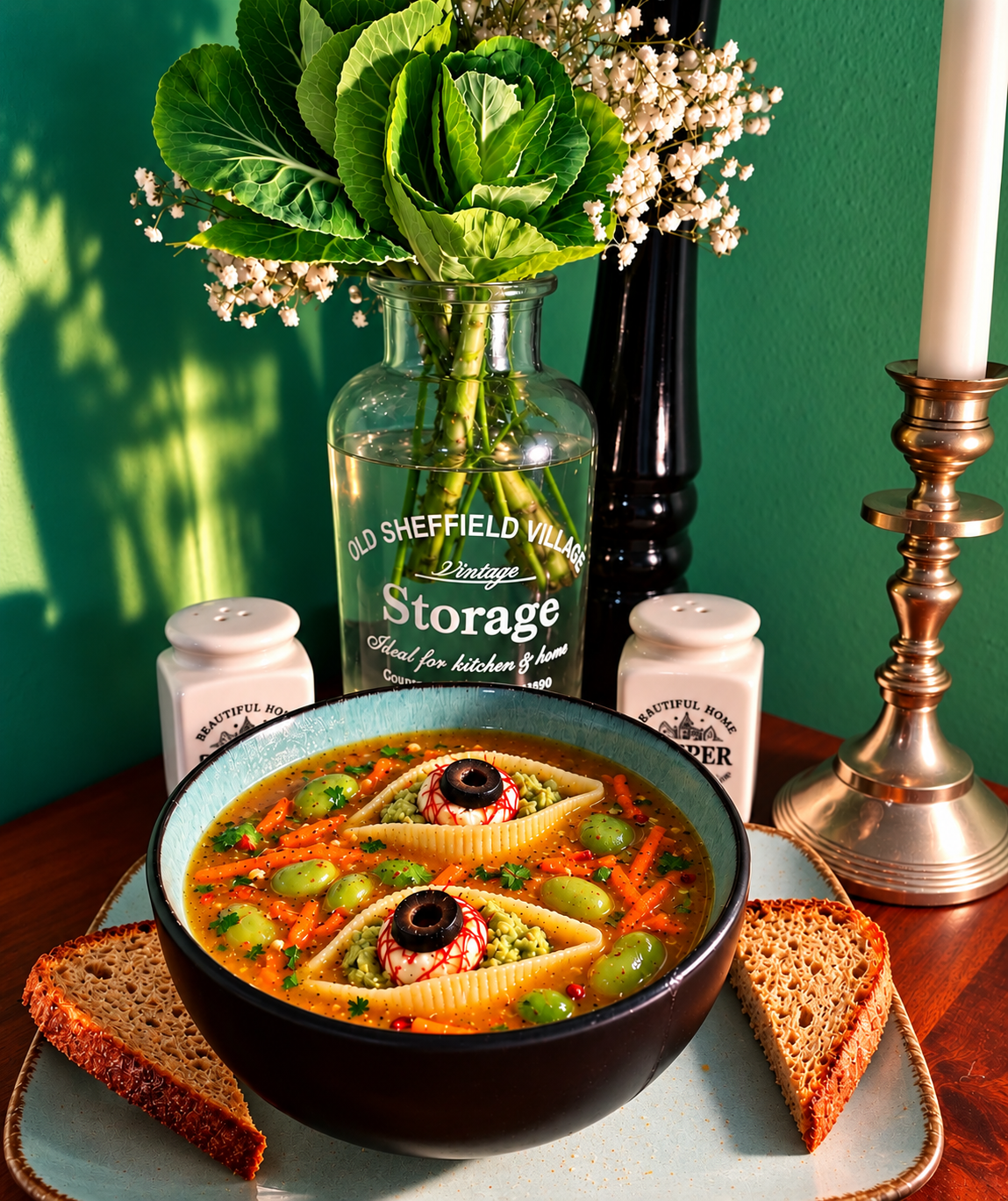
Kusksu bil-Ful is a traditional Maltese springtime soup made with broad beans, vegetables and tiny pasta pearls called kusksu. Depending on the family recipe, it may also include poached eggs and fresh Maltese cheeselets known as ġbejniet. For my Via Veggie Vegan Halloween interpretation, I replaced the traditional pasta pearls with giant conchiglioni shells and transformed vegan mozzarella, black olives and delicate chili threads into spooky edible eyeballs. The thick tomato and vegetable broth, flavored with rosemary and nutritional yeast, makes this comforting Maltese classic a deliciously playful Halloween creation.
▣ Ingredients (2 servings)
- 8 giant conchiglioni pasta shells, including 4 spare shells in case of breakage
- 225 g shelled fresh or frozen broad beans (fava beans)
- 1 onion
- 1 1/2 tbsp tomato paste
- 1 small potato
- 1 medium carrot
- 500 ml vegetable stock
- 2 tbsp extra virgin olive oil
- 2 sprigs fresh rosemary
- 1 tbsp nutritional yeast
- 40 g vegan mozzarella alternative
- 2 pitted black olives
- 1 pinch fine read chili threads
- to taste salt & freshly ground black pepper
♨ Preparation
- Prepare the Vegetables
Peel and finely dice the onion and garlic.
Peel the potato and cut it into small cubes.
Peel the carrot and cut it into small cubes or thin strips.
If using fresh broad beans, remove them from their pods. For a particularly tender texture, remove the outer skin from larger beans if necessary.
Frozen broad beans can be used directly, following the package instructions. - Prepare the Aromatic Base
Heat the olive oil in a large saucepan over medium heat.
Add the diced onion and sauté until translucent.
Stir in the garlic and continue cooking gently until fragrant, without allowing it to brown. - Add the Vegetables
Add the diced potato, carrot and broad beans.
Season lightly with salt and freshly ground black pepper.
Stir well and sauté briefly to combine the flavors. - Build the Soup
Add the tomato paste and stir for approximately one minute to develop its flavor.
Pour in the hot vegetable stock.
Add the two sprigs of fresh rosemary.
Bring the soup to a gentle boil, then reduce the heat.
Cover and simmer for approximately 10–12 minutes, until the vegetables begin to soften. - Cook the Conchiglioni
Meanwhile, bring a separate saucepan of salted water to a boil.
Add the eight giant conchiglioni pasta shells and cook according to the package instructions until tender but still firm enough to hold their shape.
Stir carefully to prevent sticking.
Drain gently and allow the shells to cool slightly.
Select the four best-shaped shells for serving. Keep the remaining shells as spares or use them in another dish.
Cooking the conchiglioni separately helps preserve their shape and prevents them from becoming damaged while stirring the soup. - Finish the Soup
Remove the rosemary sprigs and stir in the nutritional yeast.
Using a fork or potato masher, gently mash approximately one-third of the cooked potatoes and broad beans directly in the saucepan.
Stir thoroughly until the soup develops a thick, creamy, stew-like consistency while the remaining vegetables retain their shape.
If necessary, simmer uncovered for another 3–5 minutes to reduce excess liquid.
Season with salt and freshly ground black pepper. - Create the Halloween Eyeballs
Divide the vegan mozzarella alternative into two portions.
Gently knead or shape each portion into a small round ball.
If the mozzarella alternative is too soft, refrigerate it briefly before shaping.
Place a ring of black olive on top of each mozzarella ball to create the pupil.
Carefully arrange fine red chili threads across the surface to resemble bloodshot veins.
The result should be two slightly creepy but entirely edible Halloween eyeballs. - Assemble the Pasta Eyes
Place two cooked conchiglioni shells in each serving bowl, arranging them with their openings facing upward.
Spoon a small amount of the cooked broad beans into the shells to create a stable base.
Carefully position one mozzarella eyeball in the center of each bowl, resting it between or inside the two pasta shells.
The pasta should resemble a pair of open eyelids surrounding the eyeball. - Serve
Divide the thick broad bean soup between two bowls.
Carefully arrange two cooked conchiglioni shells on the surface of each serving.
Place one prepared mozzarella eyeball between the shells in each bowl, using the pasta as support.
Make sure the soup is thick enough to support the decorations and keep the eyeballs clearly visible.
Finish with freshly ground black pepper and serve immediately.
Food Story
From Humble Fava Beans to Culinary Obsession
Some people collect shoes. Others collect handbags. I collect culinary obsessions. And about ten years ago, I developed a rather unexpected one: fava beans. Back then, at least where I was shopping, these wonderful little beans were something I usually found in delicatessen shops rather than ordinary supermarkets. Which is actually quite funny, considering their history. For centuries, fava beans were an affordable staple throughout the Mediterranean. In parts of southern Italy, they were even known as the meat of the poor. From humble peasant food to delicatessen shelves. Now that’s what I call a successful rebranding campaign! And since I happen to be a self-confessed soup lover – or Suppenkasper, as we say in Germany – it was only a matter of time before my beloved fava beans ended up in a big bowl of soup.
The Soup Is Watching You!
This time, my culinary journey took me to Malta. Kusksu bil-Ful is traditionally a comforting springtime soup with broad beans, tiny pasta pearls, poached eggs and fresh Maltese cheeselets. Sounds wonderful. But there was one tiny problem. It’s October. Halloween season. And apparently, I am physically incapable of leaving perfectly innocent food alone during Halloween. So the traditional pasta pearls had to make way for giant conchiglioni shells. The eggs and cheeselets were replaced with vegan mozzarella eyeballs, complete with black olive pupils and delicate red chili veins. Suddenly, my comforting Maltese soup was staring right back at me. A little rosemary, nutritional yeast and plenty of Mediterranean flavor completed the transformation. And there it was: a deliciously warming bowl of Maltese comfort food with two rather suspicious-looking eyes floating on the surface. I suppose most people would be slightly concerned if their lunch started watching them. Me? I was delighted. After all, Halloween only comes once a year. And if you’re going to play with your food, you might as well make it delicious. Via Veggie Vegan – A Culinary Journey Around the World.
♨ Nutrition per serving
Nutritional values are approximate and may vary depending on the ingredients and products used.
Good to Know
What Is Kusksu bil-Ful?
Kusksu bil-Ful is a traditional Maltese soup particularly associated with spring, when fresh broad beans are in season. Its name refers to kusksu, a type of tiny pasta pearl, and ful, the Maltese word for broad beans. Although the pasta resembles couscous, traditional kusksu is a distinct pasta product rather than North African couscous.
What Are the Traditional Ingredients?
Traditional Kusksu bil-Ful combines broad beans, small pasta pearls, vegetables and a flavorful broth. Depending on the family recipe, it may also contain fresh eggs poached directly in the soup and small Maltese sheep's or goat's milk cheeselets called ġbejniet. Fresh parsley is another common finishing ingredient. For my vegan Halloween version, I omitted the eggs, dairy cheese and traditional kusksu pasta. Instead, I used giant conchiglioni shells and created edible eyeballs from vegan mozzarella alternative, black olives and red chili threads.
What Are Fava Beans?
Fava beans, also known as broad beans, belong to the species Vicia faba. They are among the oldest cultivated legumes and have been an important ingredient in Mediterranean and Middle Eastern cuisines for thousands of years. In German, they are commonly known as Ackerbohnen, Saubohnen or Dicke Bohnen. They have a slightly earthy, nutty flavor and are particularly delicious in soups, stews, purées and traditional bean dishes.
How Much Protein Do Fava Beans Contain?
Fava beans are a valuable source of plant-based protein. According to USDA food composition data, 100 g of cooked mature fava beans provide approximately 7.6 g of protein, while 100 g of dried mature fava beans contain approximately 26 g of protein. Young green fava beans have a different nutritional composition, with approximately 4.8 g of protein per 100 g when cooked. The difference is largely due to their maturity and water content. For accurate nutritional comparisons, it is important to distinguish between dried, cooked mature and young green beans. Fava beans also provide dietary fiber, folate and other important nutrients.
Were Fava Beans Originally a Poor Person's Food?
Yes. Throughout parts of the Mediterranean, fava beans were traditionally an inexpensive and nourishing food, particularly important in rural and less affluent households. In southern Italy, broad beans were sometimes described as the meat of the poor because they provided valuable plant-based protein at a much lower cost than meat. Malta also has a long tradition of broad bean dishes, including bigilla, a rustic bean spread that was historically sold as an affordable everyday food. Interestingly, these humble ingredients are now celebrated in restaurants and specialty food shops.
What Do Fava Beans Have to Do with Halloween?
Broad beans have a fascinating historical connection to death and remembrance in several Mediterranean cultures. In Malta, traditional broad bean dishes such as bigilla were associated with funeral customs, while in parts of Italy broad beans were connected with commemorations of the dead. These traditions are not the same as modern Halloween celebrations, but they make fava beans an unexpectedly fitting ingredient for a spooky autumn recipe.
What Are Conchiglioni?
Conchiglioni are large Italian shell-shaped pasta pieces traditionally used for stuffing and baking. Their deep, curved shape makes them ideal for holding fillings and, in this recipe, for creating the appearance of open eyelids around the Halloween eyeballs. Because of their size and thickness, they generally require longer cooking than small soup pasta. Always check the package instructions, as cooking times vary between manufacturers.
Why Should This Halloween Soup Be Thick?
Traditional Kusksu bil-Ful develops its hearty consistency partly because the small pasta pearls release starch directly into the broth. In this Halloween interpretation, the giant conchiglioni shells are cooked separately to preserve their shape. Reducing the vegetable stock to 500 ml and gently mashing some of the potatoes and broad beans creates a naturally thickened soup that helps support the floating pasta eyes.
What Is Kunserva?
Kunserva is a traditional Maltese concentrated tomato paste known for its rich, slightly sweet tomato flavor. It is commonly used to add depth to soups, stews and sauces. In this recipe, kunserva adds a concentrated tomato note that complements the broad beans, vegetables and fresh rosemary.
You may also like
♡
You may also like
Vegan Ukrainian Borscht – Traditional Beetroot & Cabbage Soup with Dill and Sour Cream
You may also like
Serbian Zucchini & Carrot Soup – Vegan Čorba sa Tikvicama i Šargarepom
You may also like