
Finland – The Land of a Thousand Lakes
Finland is a Nordic country known for its forests, countless lakes, long winters and strong connection to nature. Its traditional cuisine reflects the country's geography and climate, with potatoes, root vegetables, rye bread, berries, mushrooms and fish playing important roles. Simple, warming soups are particularly popular, and fresh herbs such as dill bring characteristic Nordic flavors to many dishes.
What Is Lohikeitto?
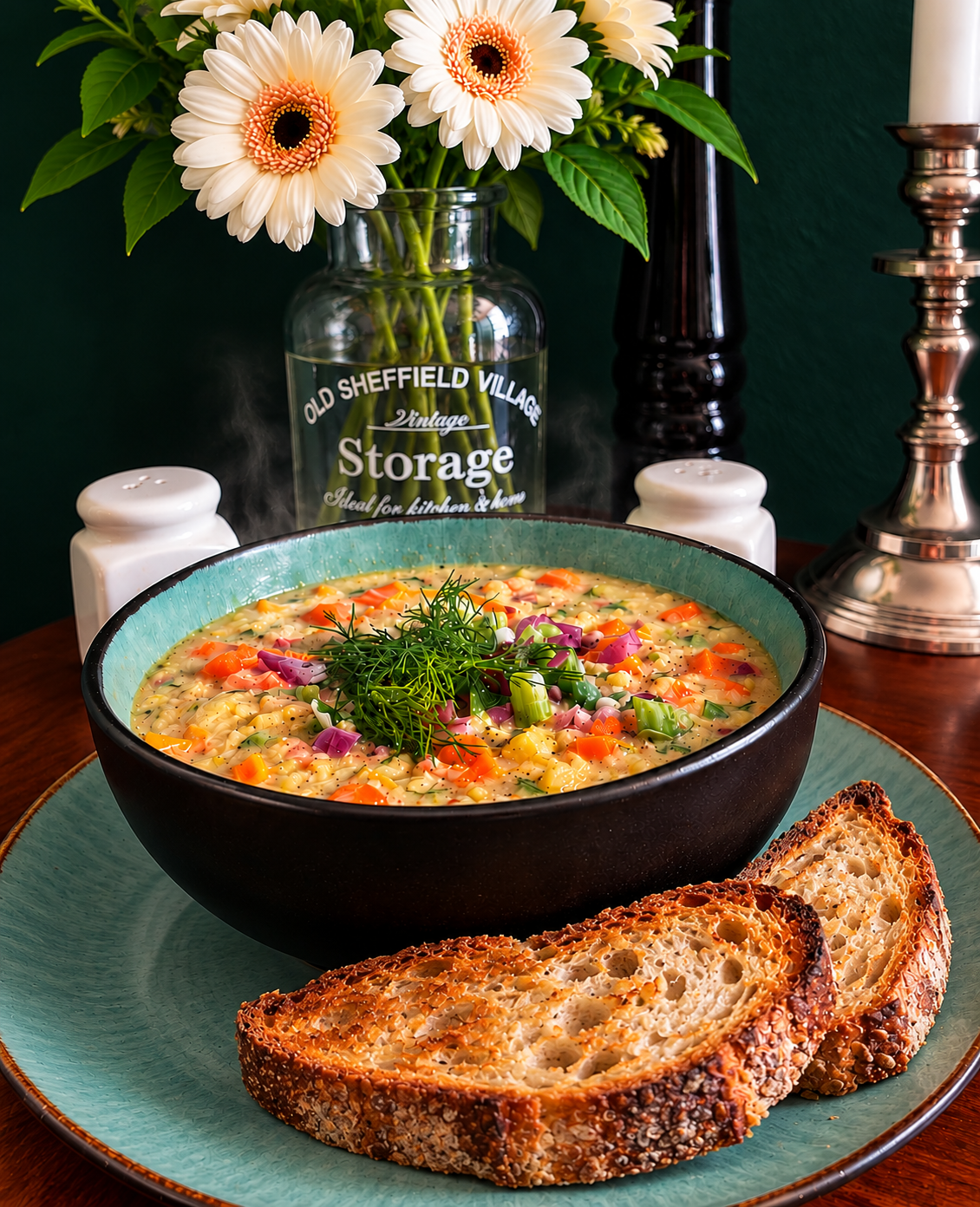
Lohikeitto is a traditional Finnish salmon soup made with fresh salmon, potatoes, leek, often carrots, cream and fresh dill. The name comes from the Finnish words "lohi" (salmon) and "keitto" (soup). My vegan interpretation replaces the salmon with homemade carrot lox, marinated in nori, soy sauce, lemon and liquid smoke. Oat cream and unsweetened oat drink create a rich, comforting broth without dairy, while the classic combination of potatoes, vegetables and dill remains.
▣ Ingredients (2 servings)
- 4 carrots
- 1 tsp salt
- 2 tbsp olive oil
- 1 1/2 tbsp soy sauce
- 1 tbsp lemon juice
- 1 tsp apple cider vinegar
- 1 tsp maple syrup
- 1 tsp liquid smoke
- 1 tsp nori flakes
- 1/2 tsp smoked paprika
- 1 tsp fresh dill
- 2 tbsp vegan butter
- 1 leek
- 1 onion
- 400 g waxy potatoes
- 600 ml vegetable stock
- 1 tsp norik flakes
- 5 allapice berries
- 2 bay leaves
- 250 ml oat creme
- 150 ml unsweetened oat milk
- 1 bunch fresh dill
- to taste salt % pepper
- to taste lemon juice & zest
♨ Preparation
- Prepare the Carrot Ribbons
Peel the three large carrots.
Using a vegetable peeler, slice them lengthwise into wide, thin ribbons. Avoid making them paper-thin, as they should retain enough structure to resemble delicate slices of salmon.
Bring a saucepan of water to a boil and add 1 teaspoon of salt.
Blanch the carrot ribbons for approximately 2–3 minutes until soft and flexible but still slightly firm.
Drain thoroughly and allow them to steam dry briefly. - . Prepare the Carrot Lox Marinade
Combine the olive oil, soy sauce, lemon juice, apple cider vinegar, maple syrup, liquid smoke, nori flakes, smoked paprika, finely chopped dill and freshly ground black pepper in a bowl.
Stir thoroughly until the ingredients form an aromatic marinade.
Add the slightly warm carrot ribbons and gently toss until evenly coated.
Transfer everything to an airtight container.
Refrigerate for at least 12 hours, preferably 24 hours, turning the carrots gently once or twice during marinating.
Remove the Carrot Lox from the refrigerator approximately 15 minutes before using. - Prepare the Soup Vegetables
Wash the leek thoroughly to remove any soil trapped between the layers.
Slice the white and light-green parts into thin rings.
Peel and finely dice the onion.
Peel the potatoes and cut them into evenly sized cubes.
Peel the two additional carrots and cut them into small, even pieces. - Sauté the Leek and Onion
Melt the vegan butter in a large saucepan over medium heat.
Add the sliced leek and diced onion.
Sauté gently until soft and translucent, stirring occasionally.
Avoid browning the vegetables, as Lohikeitto traditionally has a delicate flavor. - Cook the Potatoes and Carrots
Add the diced potatoes and chopped carrots to the saucepan.
Stir briefly to combine them with the softened leek and onion.
Pour in the vegetable stock.
Add the nori flakes, lightly crushed allspice berries and bay leaves.
Bring to a gentle boil, then reduce the heat.
Simmer for approximately 15–20 minutes until the potatoes and carrots are tender. - Make the Broth Creamy
Reduce the heat to low.
Pour in the oat cream and unsweetened oat milk.
Stir gently and allow the soup to heat through without boiling vigorously.
Remove the bay leaves and, if preferred, the allspice berries.
Season with salt and freshly ground black pepper.
Add a little fresh lemon juice to taste.
Finely chop the fresh dill and stir a generous amount into the soup. - Add the Homemade Carrot Lox
Remove the marinated carrot ribbons from their container and allow any excess marinade to drain away.
Do not rinse them.
Gently fold some of the Carrot Lox into the finished soup immediately before serving.
Avoid prolonged cooking, as the ribbons should retain their delicate texture and smoky, savory flavor. - Garnish and Serve
Divide the hot Lohikeitto between two bowls.
Arrange the remaining Carrot Lox decoratively on top.
Finish with plenty of freshly chopped dill, freshly ground black pepper and finely grated lemon zest.
Serve immediately.
Food Story
Once Upon a Time, There Was a Salmon Lover…
Once upon a time, back when I was still a carnivore, I absolutely loved salmon. Smoked salmon in particular was one of those foods I genuinely enjoyed. So when I first heard that people were making vegan salmon out of carrots, I was more than a little skeptical. Carrots? Seriously? How on earth were they supposed to taste anything like salmon?
The Carrot Lox Experiment
But as we say in Germany, “Probieren geht über Studieren” – sometimes you just have to try something instead of overthinking it. So, long before I started my culinary journey around the world, I made my very first batch of carrot lox. And guess what? It worked! The smoky marinade, the delicate texture, the salty and slightly maritime flavors – I was genuinely impressed. Of course, carrots don’t magically turn into fish. But they can become something absolutely delicious in their own right.
From Salmon to Carrots – A Very Happy Ending
For my Finnish Lohikeitto, those homemade carrot ribbons finally got another starring role. Traditional salmon soup became a creamy vegan comfort food, with potatoes, leek, dill and plenty of smoky carrot lox. And the best part? No salmon needed. No contribution to the demand for wild-caught salmon. Just vegetables doing something rather extraordinary. Not bad for a humble carrot, is it?
Same Carrots, Two Different Jobs
And there’s another little twist I love about this recipe: traditional Lohikeitto often contains both salmon and carrots. My version keeps the carrots but gives some of them a promotion. A few stay in the soup as vegetables, while the others dress up as salmon. Five carrots, two jobs, one delicious Finnish-inspired soup. Now that’s what I call teamwork!
♨ Nutrition per serving
Nutritional values are approximate and may vary depending on the ingredients and products used.
Good to Know
What Does Lohikeitto Mean?
The Finnish name is wonderfully straightforward. "Lohi" means salmon and "keitto" means soup. Lohikeitto therefore literally translates as "salmon soup". It is one of Finland's best-known traditional soups and is especially appreciated as a warming, comforting meal.
What Makes Traditional Finnish Lohikeitto Special?
Traditional Lohikeitto is made with relatively few ingredients: fresh salmon, potatoes, leek, cream, dill and often carrots. Some recipes include allspice berries and bay leaves for a subtle aromatic background. The result is a mild, creamy soup in which the individual ingredients remain recognizable rather than being overwhelmed by spices.
Salmon and Carrots – Two Ingredients Become One
Traditional Finnish Lohikeitto often contains both salmon and carrots. In this vegan interpretation, carrots take on two different roles. Two carrots remain in the soup as vegetables, while three larger carrots are transformed into homemade carrot lox.
This means the original salmon ingredient can be replaced entirely without introducing a completely different vegetable. The carrots were already part of the traditional flavor combination – they simply receive a second job.
Fresh Salmon or Smoked Salmon?
Authentic Finnish Lohikeitto is generally prepared with fresh salmon rather than smoked salmon. The fish is usually added towards the end of cooking so it stays tender.
This vegan version takes a slightly different approach by using smoky carrot lox. The result is not an exact reproduction of traditional Lohikeitto, but a plant-based interpretation that combines the soup's familiar ingredients with the distinctive flavor of homemade carrot lox.
What Exactly Is Carrot Lox?
Carrot lox is a plant-based alternative inspired by cured or smoked salmon. Thin carrot ribbons are softened and then marinated with ingredients that create salty, smoky, savory and slightly maritime flavors.
The name "lox" traditionally refers to cured salmon, although the term is often associated with smoked salmon in everyday food culture. Carrot lox borrows the idea of delicate, seasoned slices without using fish.
Why Does Carrot Lox Taste Surprisingly Similar to Smoked Salmon?
Carrots do not naturally taste like salmon. Their transformation comes from a combination of texture and carefully balanced flavors.
Blanching softens the ribbons, making them flexible and delicate. Soy sauce contributes salt and umami, nori provides marine notes, and liquid smoke adds the characteristic smoky aroma. Lemon juice and apple cider vinegar bring acidity, while maple syrup balances the marinade.
The finished carrot lox has its own distinct character rather than being chemically or nutritionally identical to fish.
Why Is Marinating Time So Important?
Marinating allows the carrot ribbons to absorb flavors from the surrounding liquid. Salt, acidity and aromatic ingredients gradually influence the taste of the softened carrot surfaces.
A short marinating time may produce a pleasant result, but the flavor generally becomes more developed after 12–24 hours. Keeping the ribbons in a covered container in the refrigerator helps maintain food safety and prevents them from drying out.
What Is Liquid Smoke?
Liquid smoke is a concentrated flavoring produced by capturing and condensing smoke from burning wood under controlled conditions. It is used to introduce smoky aromas without directly smoking the food.
Because its intensity varies between products, a small quantity is usually sufficient. Starting with half a teaspoon and adjusting gradually helps avoid an overpowering flavor.
Why Use Nori Flakes?
Nori is an edible seaweed commonly used in Japanese cuisine. Its distinctive savory and marine flavor makes it useful in plant-based alternatives to fish and seafood.
In this recipe, nori appears in both the carrot lox marinade and the soup broth, creating a subtle connection between the two components.
Seaweed products can vary in iodine content. Nori generally contains less iodine than some other seaweeds, such as kombu, but quantities and nutritional values still depend on the product.
Why Soy Sauce and Lemon Work So Well Together
Soy sauce provides saltiness and umami, while lemon contributes brightness and acidity. Together, they create a savory flavor profile that works particularly well with dill, seaweed and the natural sweetness of carrots.
Since soy sauce already contains salt, taste the finished soup before adding additional seasoning.
Why Is Fresh Dill Essential?
Dill is one of the defining flavors of Finnish Lohikeitto. Its fresh, grassy and slightly sweet aroma complements the creamy broth and the traditional combination of potatoes and salmon.
In this vegan version, dill also balances the smoky marinade and adds freshness to the carrot lox. Adding most of it near the end of cooking helps preserve its aroma and color.
Why Use Waxy Potatoes?
Waxy potatoes contain relatively little starch compared with floury varieties and tend to hold their shape during cooking. This makes them especially suitable for soups in which tender, recognizable potato pieces are desired.
Cutting the potatoes into similar-sized cubes helps them cook evenly.
Why Use Allspice and Bay Leaves?
Allspice berries contribute warm, aromatic notes reminiscent of several familiar spices, while bay leaves add subtle herbal depth.
Both ingredients should remain in the background rather than dominating the soup. Remove the bay leaves before serving and remove the allspice berries if preferred.
Oat Cream and Oat Drink – A Dairy-Free Alternative
Traditional Lohikeitto often contains dairy cream. Oat cream provides a rich, smooth texture, while unsweetened oat drink makes the broth lighter without sacrificing its comforting character.
Choose unsweetened products without vanilla flavoring. Their fat and protein contents vary between brands and influence the final consistency of the soup.
Carrots and Beta-Carotene
Carrots are well known for their beta-carotene content. Beta-carotene is a carotenoid pigment responsible for much of their orange color, and the body can convert it into vitamin A as needed.
Vitamin A supports normal vision, immune function and the maintenance of healthy skin and mucous membranes. Including some dietary fat, such as the olive oil in the marinade, can support the absorption of fat-soluble carotenoids.
Does Carrot Lox Provide the Same Nutrients as Salmon?
No. Carrot lox can reproduce some of the culinary experience of smoked salmon, but its nutritional composition is very different.
Salmon is naturally rich in protein and provides the long-chain omega-3 fatty acids EPA and DHA. Carrots contain far less protein and do not provide comparable amounts of EPA and DHA.
For a balanced vegan diet, reliable sources of protein and omega-3 fatty acids should come from other foods. Legumes, tofu, tempeh and soy products are useful protein sources, while algae-based supplements can provide EPA and DHA directly.
What About Overfishing?
Choosing carrot lox instead of salmon reduces the demand for fish in this particular meal. This can be one way to enjoy familiar flavors while avoiding direct consumption of salmon.
However, salmon sustainability is more complex than a simple distinction between sustainable and unsustainable fish. Wild salmon populations face different pressures depending on the region, including fishing, habitat degradation and climate change. Farmed salmon raises separate environmental and animal-welfare questions.
Plant-based alternatives offer a practical way to reduce reliance on fish without giving up the pleasure of preparing flavorful, satisfying meals.
Why Fish-Free Does Not Automatically Mean Nutritionally Complete
A vegan replacement can be delicious and environmentally appealing without matching every nutrient provided by the animal-based ingredient.
Carrot lox is primarily a flavorful vegetable preparation rather than a concentrated protein source. This Lohikeitto is rich in vegetables and carbohydrates from potatoes, but its protein content is relatively modest.
A balanced plant-based diet should include sufficient protein, vitamin B12 and other essential nutrients across the day rather than expecting every individual recipe to provide everything.
What About Cholesterol?
Carrots, potatoes and other unprocessed plant foods naturally contain no cholesterol. The plant-based ingredients used in this recipe also avoid the cholesterol found in animal-derived cream and salmon.
However, dietary cholesterol is only one factor affecting blood cholesterol. The amount and type of fat consumed, especially saturated fat, also matter.
HDL, LDL and the Role of Dietary Fat
LDL particles transport cholesterol through the bloodstream, and elevated LDL cholesterol is a well-established cardiovascular risk factor. HDL particles participate in cholesterol transport away from peripheral tissues, but a higher HDL value alone does not necessarily guarantee better cardiovascular health.
Replacing some saturated fats with unsaturated fats can help lower LDL cholesterol. Olive oil, used in the carrot lox marinade, provides predominantly unsaturated fatty acids.
Plant-based cream products vary in their fat composition, so checking the ingredients and nutrition label remains useful.
Zero Waste – Use the Whole Leek
Do not throw away the dark-green leaves of the leek. The tender white and light-green parts are ideal for Lohikeitto, but the tougher dark-green leaves can still be useful.
Wash them thoroughly to remove trapped soil, then freeze them with other clean vegetable trimmings. Once you have collected enough, use them to prepare homemade vegetable stock.
Zest First, Juice Second
When using fresh lemons, grate the zest before squeezing out the juice. It is much easier to remove the zest from a whole lemon than from an already squeezed half.
Use only the colored outer layer and avoid the bitter white pith. Leftover zest can be frozen in a small airtight container for future recipes.
What Can You Do with Leftover Carrot Lox?
Carrot lox is delicious beyond this Finnish soup. Serve it on toasted bread with vegan cream cheese, add it to bagels with cucumber and dill, or use it as a topping for savory breakfast dishes.
Keep unused carrot lox refrigerated in a clean, airtight container and use it promptly. Do not leave it at room temperature for extended periods.
Can Lohikeitto Be Prepared in Advance?
The vegetable soup can be prepared ahead and refrigerated promptly. Store any unused carrot lox separately so it retains its texture and flavor.
When reheating, warm the soup gently rather than boiling it vigorously. Add the carrot lox only after reheating and finish with fresh dill and lemon zest.
You may also like
♡
You may also like
Vegan Ukrainian Borscht – Traditional Beetroot & Cabbage Soup with Dill and Sour Cream
You may also like
Estonian Kohlrabi Soup – Creamy Vegan Kohlrabisupp
You may also like