Georgia – Where Europe and Asia Meet
Georgia lies in the Caucasus region, between the Black Sea and the mountains of the Greater Caucasus. Its cuisine is famous for generous hospitality, fresh herbs, walnuts, garlic, aromatic spices and a remarkable variety of vegetable and bean dishes. Traditional Georgian meals often feature several small plates shared around the table, creating a colorful combination of flavors and textures. Walnuts are especially important in Georgian cooking, appearing in sauces, spreads, vegetable dishes and fillings.
Charkhlis Pkhali & Mtsvane Lobio – Two Georgian Specialties
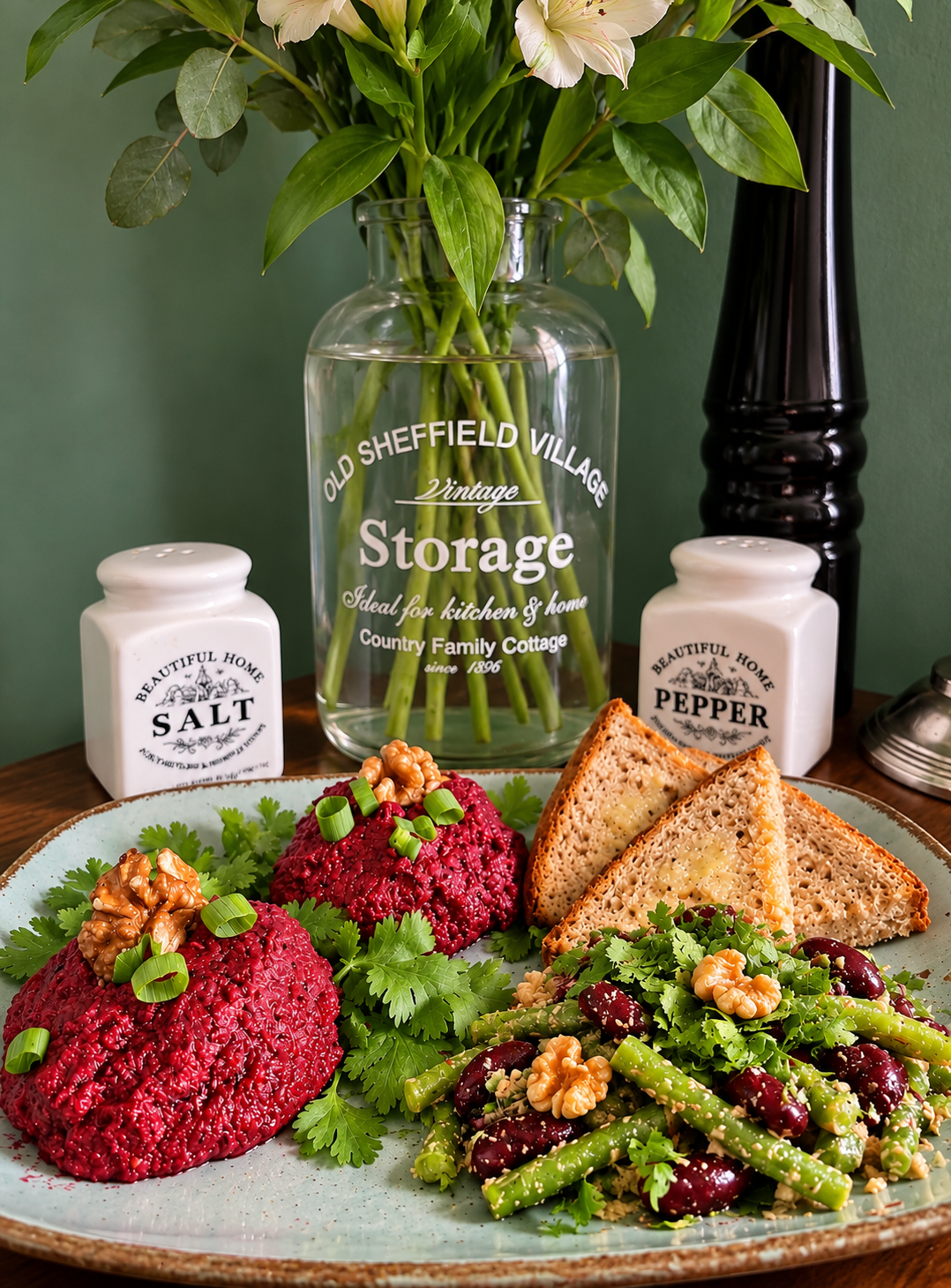
Charkhlis Pkhali (ჭარხლის ფხალი) is a beetroot variation of Pkhali, a family of Georgian vegetable dishes prepared with ground walnuts, garlic, herbs and spices. Beetroot Pkhali is commonly made with cooked beetroot, but this Via Veggie Vegan version uses fresh raw beetroot for a firmer texture and particularly earthy flavor. Mtsvane Lobio (მწვანე ლობიო) means green beans and refers to Georgian preparations centered on this vegetable. My interpretation combines green beans with red kidney beans, fresh coriander and a walnut dressing enriched with pomegranate molasses and lemon juice. Served together with toasted bread, the two dishes make a satisfying plant-based meal.
▣ Ingredients (2 servings)
- 300 g raw beetroot
- 60 g walnuts (save some for garnish)
- 1 clove garlic
- 1 onion
- 2 sprigs fresh coriander
- 2 sprigs fresh parsley
- 1 tbsp | white wine vinegar or red wine vinegar
- 3/4 tsp ground coriander
- 1/4 tbs blue fenugreek
- 1/2 tsp sweet paprika powder
- 1 spring onion (for garnish)
- 200 g green beans
- 1/2 can kidney beans
- 35 g walnuts
- 1 onion
- 1 clove garlic
- 1 tbsp vegetable oil
- 1 sprig coriander
- 1/4 tsp fenugreek
- 1/4 tsp ground coriander
- 1 pinch cayenne pepper
- 1 tbsp pomegranate molasses
- 1/2 lemon
- 1 1/2 tbsp warm water
- to taste salt & freshly ground pepper
- 2 slices bread
♨ Preparation
- Charkhlis Pkhali
Toast the Walnuts
Heat a dry frying pan over medium heat.
Add the walnuts and toast gently for approximately 3–4 minutes, stirring regularly.
The walnuts should become fragrant and lightly toasted without burning.
Remove from the heat and allow them to cool completely.
Reserve a few walnut pieces for garnishing. - Prepare the Raw Beetroot
Wash and peel the raw beetroot.
Cut it into smaller pieces.
Using a food processor or kitchen grater, finely grate the beetroot.
The texture should be fine enough to combine easily with the walnut mixture while retaining a little natural structure.
If the beetroot releases excessive liquid, gently squeeze out a small amount to prevent the finished pâté from becoming too watery. - Prepare the Aromatics
Peel the garlic clove and onion.
Cut the onion into smaller pieces.
Wash the fresh coriander and flat-leaf parsley.
Shake off excess water and roughly chop the herbs. - Prepare the Walnut Mixture
Place the cooled walnuts, garlic and onion into a food processor.
Pulse until the ingredients form a finely ground mixture.
Avoid processing too long, as the walnuts should retain a little texture. - Combine the Beetroot and Spices
Add the finely grated raw beetroot to the walnut mixture.
Add the fresh coriander, parsley, ground coriander, blue fenugreek and sweet paprika powder.
Pour in the vinegar.
Season with salt and freshly ground black pepper. - Blend the Pkhali
Process briefly until the ingredients form a thick, spreadable pâté.
The mixture should be evenly combined but retain some texture.
Avoid overprocessing, as raw beetroot can release additional moisture.
Taste and adjust the seasoning if necessary. - Chill the Pkhali
Transfer the mixture to a bowl.
Cover and refrigerate for at least 1 hour.
This allows the garlic, herbs, walnuts and spices to develop a more balanced flavor.
Chilling also helps the mixture become easier to shape.
Part 2 – Mtsvane Lobio - Mtsvane Lobio
Cook the Green Beans
Trim the green beans and cut them into bite-sized pieces.
Bring a saucepan of salted water to a boil.
Add the green beans and cook for approximately 8–10 minutes until tender but still slightly firm.
Drain and immediately rinse under ice-cold water to stop the cooking process.
Allow the beans to drain thoroughly. - Prepare the Onion
Peel and finely dice the onion.
Heat the vegetable oil in a frying pan over medium heat.
Add the onion and cook for approximately 5 minutes until soft and translucent.
Avoid browning.
Remove from the heat and allow to cool slightly. - Prepare the Walnut Dressing
Finely grind approximately 30 g of the walnuts.
Reserve the remaining 5 g for garnishing.
Place the ground walnuts in a bowl.
Add the crushed garlic, fenugreek, ground coriander, chili flakes or cayenne pepper, salt and freshly ground black pepper.
Stir in the pomegranate molasses.
Add 1–1.5 tablespoons of warm water.
Mix until a thick, creamy walnut dressing forms. - Combine the Green and Red Beans
Drain and rinse the red kidney beans thoroughly.
Place the cooked green beans and red kidney beans in a large bowl.
Add the sautéed onion together with its cooking oil.
Add most of the chopped fresh coriander.
Spoon the walnut dressing over the beans.
Gently mix until everything is evenly coated. - Add the Lemon and Rest
Squeeze the half lemon.
Add the freshly squeezed lemon juice to the bean salad.
Mix gently and adjust the seasoning.
Allow the Mtsvane Lobio to rest for approximately 15 minutes.
Meanwhile, lightly toast the reserved walnuts in a dry frying pan until fragrant. - Garnish and Serve
Shape the Charkhlis Pkhali
Remove the chilled beetroot and walnut mixture from the refrigerator.
Using slightly damp hands or two spoons, shape it into two generous oval portions or decorative quenelles.
Arrange the Pkhali on one side of the serving plate.
Garnish with walnut pieces, finely sliced spring onions and fresh coriander. - Arrange the Mtsvane Lobio
Spoon the green bean and red kidney bean salad onto the other side of the plate.
Scatter the toasted walnuts and remaining fresh coriander over the salad. - Prepare the Toasted Bread
Lightly toast the bread until golden and crisp.
Cut into triangles or serve in slices. - Serve the Georgian Platter
Arrange the toasted bread alongside the Charkhlis Pkhali and Mtsvane Lobio.
Serve both dishes cold or at room temperature.
The vibrant ruby-red beetroot pâté, green beans, red kidney beans, fresh herbs and toasted walnuts create a beautiful contrast of colors, flavors and textures.
Food Story
Red or Green? That Was the Question!
When I arrived in Georgia on my culinary journey around the world – without actually leaving my kitchen, of course – I found myself facing a rather delicious dilemma. I had two Georgian dishes in mind: Charkhlis Pkhali, a gorgeous ruby-red beetroot and walnut pâté, and Mtsvane Lobio, a green bean dish with walnuts, garlic and fresh herbs. Both sounded wonderful. So which one should I cook? Red or green? Apparently, I wasn’t in the mood to make a difficult decision. So naturally, I made both!
And Then Came Another Decision…
For the Mtsvane Lobio, I had another idea. Why stop at green beans when I could add red kidney beans as well? A little more color, a little more texture and an even more satisfying salad. Red and green it was! And since I was already giving the traditional recipes my own twist, I decided to use fresh raw beetroot for the Charkhlis Pkhali instead of the more commonly used cooked version. I love its earthy flavor, its fresh texture and, of course, that spectacular deep-red color.
Walnuts, Garlic and Coriander – Obviously!
Both dishes turned out to be wonderfully aromatic. The beetroot pâté was rich, earthy and slightly tangy, while the bean salad brought freshness, texture and a creamy walnut dressing to the plate. There was plenty of garlic, plenty of coriander and a generous helping of walnuts. In other words, exactly the kind of combination that makes me happy. And because all those lovely flavors deserved something to scoop them up with, I added a little toasted bread.
One Plate, Two Georgian Specialties
The result? One plate, two Georgian specialties and a beautiful contrast of red and green. It looked almost too pretty to eat. Almost! And the best part? I didn’t have to choose between the two dishes after all. Well, except for one final decision: Which one should I taste first? Welcome to Georgia – Via Veggie Vegan style!
♨ Nutrition per serving
Nutritional values are approximate and may vary depending on the ingredients and products used.
Good to Know
Georgia – A Culinary Crossroads
Georgia is located in the Caucasus, a region shaped by connections between Europe and Asia. Its geography includes mountain landscapes, fertile valleys and a Black Sea coastline. These varied environments support a diverse range of agricultural products and regional food traditions.
Georgian cuisine is particularly known for its use of walnuts, fresh herbs, garlic, beans, vegetables and distinctive spice blends. Many dishes are naturally plant-based, making the cuisine especially interesting for vegan cooking.
What Is a Georgian Supra?
A supra is a traditional Georgian feast associated with hospitality, shared dishes, toasts and conversation. It is an important cultural expression of gathering around a table.
Vegetable dishes, breads, bean preparations and walnut-based specialties can form part of a larger spread. Pkhali and Lobio are particularly well suited to this style of serving because they can be presented alongside other dishes.
What Is Pkhali?
Pkhali is a family of Georgian vegetable dishes commonly prepared by combining finely chopped or processed vegetables with ground walnuts, garlic, herbs, vinegar and spices.
Spinach, beetroot, cabbage and green beans are among the vegetables used in different versions. The mixture is often shaped into small portions and served cold or at room temperature.
What Does Charkhlis Pkhali Mean?
Charkhlis refers to beetroot, while Pkhali identifies the traditional Georgian vegetable-and-walnut preparation.
Charkhlis Pkhali is therefore a beetroot version of Pkhali. Its striking color comes from the natural pigments found in beetroot.
Is Raw Beetroot Traditional in Pkhali?
Many traditional beetroot Pkhali recipes use cooked beetroot, which produces a softer texture and a milder flavor.
This Via Veggie Vegan version uses raw beetroot instead. It is a creative adaptation that emphasizes the vegetable's fresh, earthy character and firmer texture.
Why Is Beetroot So Intensely Red?
Beetroot contains natural pigments called betalains. These compounds are responsible for its distinctive red-purple color.
Betalains are water-soluble, which explains why beetroot juice can easily stain hands, cutting boards and kitchen utensils. Wearing kitchen gloves and cleaning surfaces promptly can make preparation easier.
Raw Versus Cooked Beetroot
Raw beetroot has a firm texture and a more pronounced earthy flavor. Cooking softens the vegetable and can make its sweetness more noticeable.
Both forms contribute fiber and other nutrients to a varied diet. Cooking can change the concentration or availability of certain compounds, but neither raw nor cooked beetroot is universally superior.
Why Does Beetroot Taste Earthy?
Beetroot's characteristic earthy aroma is associated partly with a compound called geosmin.
Some people are particularly sensitive to this flavor, while others enjoy it. Walnuts, garlic, herbs and acidity help balance the earthy character in this pâté.
What Is Lobio?
Lobio is the Georgian word for beans and also refers to a broad family of bean dishes.
Different preparations may feature dried beans, fresh green beans, herbs, walnuts, garlic and spices. Some versions are warm and hearty, while others are served as lighter vegetable dishes.
What Does Mtsvane Lobio Mean?
Mtsvane means green, and Lobio means beans. Mtsvane Lobio therefore refers to green beans.
Georgian green bean dishes can be prepared in different ways, including combinations with garlic, herbs and walnuts.
Adding red kidney beans is a personal adaptation in this recipe, creating a more substantial salad with additional texture and color.
Why Are Walnuts So Important in Georgian Cuisine?
Walnuts are among the defining ingredients of Georgian cooking. They appear in vegetable dishes, sauces, fillings and appetizers.
When finely ground, walnuts create a rich, creamy texture without dairy products. Their flavor pairs particularly well with garlic, coriander, vinegar and aromatic spices.
Both dishes in this recipe demonstrate how walnuts can transform simple vegetables into satisfying, flavorful preparations.
Walnuts and Unsaturated Fats
Walnuts contain predominantly unsaturated fatty acids, including alpha-linolenic acid, a plant-based omega-3 fatty acid.
They also contribute protein, fiber and minerals. Because walnuts are energy-dense, the quantity used has a noticeable influence on the calories and fat content of the finished meal.
What Is Blue Fenugreek?
Blue fenugreek is an aromatic herb associated with Georgian cuisine and certain versions of the spice blend Khmeli Suneli.
Its flavor is mildly herbal, nutty and slightly bitter. It is different from the more widely available fenugreek seeds, which have a stronger and more distinctive flavor.
What Is Khmeli Suneli?
Khmeli Suneli is a Georgian spice blend whose composition varies between producers and households.
Depending on the mixture, it may contain blue fenugreek, coriander, marigold and other dried herbs or spices. It contributes a complex, aromatic character to many Georgian dishes.
This recipe uses individual spices rather than relying on a prepared blend.
Why Use Ground Coriander and Fresh Coriander?
Ground coriander is made from the dried seeds of the coriander plant. It has a warm, citrus-like aroma.
Fresh coriander leaves and tender stems have a brighter, more herbal flavor. Using both forms creates different layers of aroma.
Why Does Garlic Work So Well with Walnuts?
Garlic provides pungency and aromatic intensity that balance the richness of ground walnuts.
When finely processed, it distributes evenly through the pâté and dressing. Its flavor becomes more integrated after the mixtures have rested.
Why Add Vinegar to Pkhali?
Vinegar introduces acidity, which balances the natural sweetness of beetroot and the richness of walnuts.
It also helps brighten the overall flavor. The amount can be adjusted slightly according to personal preference.
Wine vinegar is produced through fermentation and may contain trace residual alcohol. Anyone who avoids even trace amounts can use a suitable alcohol-free culinary acid, such as fresh lemon juice.
What Is Pomegranate Molasses?
Pomegranate molasses is a concentrated preparation made from pomegranate juice. It has a distinctive sweet-tart flavor.
It is used in several regional cuisines to add fruity acidity and depth to sauces, marinades and dressings.
In this Mtsvane Lobio variation, it balances the rich walnut dressing and complements the fresh lemon juice.
Is Pomegranate Molasses Traditional in Lobio?
Not every traditional Georgian Lobio recipe contains pomegranate molasses.
Its inclusion here is a creative addition rather than an essential ingredient in all versions of the dish. It works particularly well with walnuts, garlic and fresh herbs.
Why Add Lemon Juice?
Lemon juice contributes fresh acidity that lifts the flavors of the bean salad.
It helps balance the richness of the walnut dressing and provides contrast to the earthy beans and aromatic spices.
Green Beans and Red Kidney Beans – What's the Difference?
Green beans are usually eaten as immature pods, while red kidney beans are mature seeds of the common bean plant.
They have different textures and nutritional profiles. Green beans provide a fresh vegetable component, while kidney beans contribute additional starch, fiber and protein.
Combining them creates a more substantial salad with contrasting textures.
Why Must Kidney Beans Be Properly Cooked?
Raw or insufficiently cooked kidney beans contain a lectin called phytohaemagglutinin, which can cause gastrointestinal illness.
Commercially canned kidney beans are already heat-treated and ready to use after draining and rinsing. If preparing dried kidney beans, follow a reliable soaking and boiling method. Slow cooking at insufficient temperatures is not a safe substitute for proper boiling.
Why Cook Green Beans Before Eating?
Green beans should be cooked thoroughly rather than eaten raw. They contain naturally occurring lectins that are reduced by adequate cooking.
Cooking also improves their texture and makes them easier to combine with the walnut dressing.
Why Rinse Cooked Green Beans with Cold Water?
Rinsing cooked green beans with very cold water stops much of the residual cooking process.
This helps prevent them from becoming excessively soft and can preserve a brighter green appearance.
Draining them thoroughly afterward is important because excess water can dilute the dressing.
Why Allow the Pkhali to Rest?
Chilling gives the garlic, herbs, spices and vinegar time to become more evenly distributed throughout the beetroot and walnut mixture.
It also allows the mixture to firm up slightly, making it easier to shape into decorative portions.
Why Rest the Bean Salad?
Allowing the Mtsvane Lobio to stand briefly helps the dressing coat the beans evenly and gives the flavors time to combine.
Because the salad contains fresh herbs, it is best not to leave it at room temperature for extended periods.
Are Pkhali and Lobio Naturally Vegan?
Many traditional Pkhali and Lobio preparations are naturally vegan because they rely on vegetables, beans, walnuts, herbs and spices.
However, recipes vary between households and restaurants, so it is always worth checking the ingredients when eating outside the home.
The two dishes in this recipe contain no meat, fish, dairy products or eggs.
Plant Protein from Beans and Walnuts
Red kidney beans and walnuts contribute plant protein to this meal.
Kidney beans also provide complex carbohydrates and fiber. Walnuts contribute protein alongside predominantly unsaturated fats.
Combining different plant foods across the day helps support a varied and nutritionally balanced vegan diet.
Why Fiber Matters
Beetroot, green beans, kidney beans and walnuts all contribute dietary fiber.
Fiber supports normal digestive function and can help promote fullness. Different plant foods contain different types of fiber, making variety useful.
People who are not accustomed to eating large amounts of legumes may find it helpful to increase their intake gradually.
What About Iron?
Beans, nuts and vegetables can contribute iron to a plant-based diet.
Plant foods contain non-heme iron, whose absorption is influenced by other components of the meal. Vitamin C can help improve its absorption.
Fresh lemon juice adds acidity and some vitamin C, although the overall nutritional contribution depends on the quantity used.
HDL, LDL and Dietary Fat
LDL particles transport cholesterol through the bloodstream. Elevated LDL cholesterol is an established risk factor for cardiovascular disease because LDL-containing particles can contribute to plaque formation in blood vessels.
HDL particles participate in cholesterol transport, but a high HDL cholesterol level alone does not guarantee cardiovascular protection.
Replacing some saturated fats with unsaturated fats can help lower LDL cholesterol. Walnuts are a useful source of unsaturated fats within a balanced diet.
Does Naturally Vegan Mean Low-Calorie?
No. A naturally vegan dish can still be relatively energy-dense, particularly when it contains generous quantities of nuts and oil.
That is not necessarily a disadvantage. Walnuts provide valuable nutrients, but their calorie contribution should be included when estimating portion sizes.
Why Serve These Dishes with Bread?
Toasted bread provides a contrasting crisp texture and makes it easy to scoop up the beetroot pâté and walnut dressing.
It also contributes additional carbohydrates, making the combined platter more substantial.
For a gluten-free meal, choose a suitable gluten-free bread and check the other packaged ingredients.
Why Food Presentation Matters
The deep red of beetroot, bright green beans, darker kidney beans and golden walnuts create a visually appealing contrast.
Serving the two dishes side by side allows their different textures and colors to remain visible.
Simple garnishes such as fresh herbs, spring onions and toasted walnut pieces can make a home-cooked meal look especially inviting.
Zero Waste – Save the Beetroot Greens
If using fresh beetroot with its leaves attached, don't throw them away.
Young beetroot greens are edible and can be prepared similarly to spinach. Wash them thoroughly and use them in soups, sautéed vegetable dishes or other cooked preparations.
Zero Waste – Use the Whole Coriander
Tender coriander stems are full of flavor and can be finely chopped along with the leaves.
Any clean, tougher stems can be saved for homemade vegetable stock. This makes better use of the entire herb bunch.
Zero Waste – Don't Waste the Lemon
Before squeezing the lemon, grate its zest if the peel is suitable for culinary use.
The zest can be stored in a small airtight container or frozen for another recipe. Its aromatic oils work particularly well in dressings, sauces and baked dishes.
Zero Waste – Save Suitable Vegetable Trimmings
Clean onion ends, suitable herb stems and other sound vegetable trimmings can be collected in the freezer for homemade vegetable stock.
Avoid spoiled ingredients and excessive amounts of strongly flavored scraps that could overpower the finished stock.
Zero Waste, Full Flavor.
Can Charkhlis Pkhali Be Prepared Ahead?
Yes. The beetroot and walnut pâté benefits from chilling and can be prepared in advance.
Store it in a covered container in the refrigerator and shape it shortly before serving. Add the final walnut and herb garnishes at the last moment.
Can Mtsvane Lobio Be Prepared Ahead?
The bean salad can also be prepared ahead and refrigerated.
For the freshest appearance, reserve some coriander and toasted walnuts for garnishing just before serving.
If the dressing thickens during storage, a very small amount of water or lemon juice can help loosen it.
How Should Leftovers Be Stored?
Store the Charkhlis Pkhali and Mtsvane Lobio separately in clean, airtight containers in the refrigerator.
Use within approximately 2 days. Because both dishes contain fresh ingredients and are served cold or at room temperature, refrigerate leftovers promptly rather than leaving them out for extended periods.
Can You Freeze These Dishes?
Freezing is not ideal for the finished platter.
Raw beetroot pâté may release additional moisture after thawing, while green beans and fresh herbs can lose some of their original texture.
For the best flavor and appearance, prepare these dishes fresh or refrigerate them for short-term storage.
What Can You Do with Leftovers?
Leftover Charkhlis Pkhali makes a delicious sandwich filling or vegetable spread.
Mtsvane Lobio can be served as a cold lunch, added to a larger salad platter or enjoyed alongside other vegetable dishes.
Both are excellent examples of how simple plant-based ingredients can be transformed into satisfying meals.